

Teeth whitening is usually possible with a tongue or lip piercing, but the gel lightens enamel only, so the first step is checking the teeth and gums next to the jewellery for chips, cracks and gum recession. In one study of 52 adults with tongue piercings, lingual gum recession was found on the lower central incisors in half of those who had worn a long barbell for two years or more. Those changes do not whiten, and on a lighter smile they can stand out more.
Written by Dr James Tran, BDent (University of Sydney), MICOI, GradDip (Oral Implants), general dentist at Lumi Dental in Melrose Park.
The short version
- A tongue, lip, labret, frenum or cheek piercing does not by itself rule out whitening. The teeth and gums beside the jewellery matter more.
- Whitening changes the colour of enamel. It does not repair chips, cracks or gum that has receded, and those areas may look more obvious once the rest of the smile is lighter.
- Tongue bars tend to affect the inner gum behind the lower front teeth; lip and labret studs tend to affect the front of the lower gum. Our article on oral piercings and dental health risks covers the risks themselves.
- Whether jewellery stays in, comes out for the session or is swapped for a different retainer is an option to talk through with your dentist and your piercer.
- A new piercing is best left to heal fully before any whitening.
- Chips and old bonding are usually repaired after whitening, once the new shade has settled.
The single rule: check what the piercing has done before you whiten
Whitening works on the enamel, not on what a piercing may already have done. A chipped edge, an exposed root or a tooth-coloured filling will not change colour with peroxide gel, and as the teeth around them lighten, the contrast can grow. So the order is examination first, then whitening, then any repairs.
In my experience, many people with a piercing have not noticed any change near the jewellery. Recession behind the lower front teeth is hard to see in a mirror, and a small chip on a back tooth may not be felt at all.
| Situation | What to check or expect with whitening |
|---|---|
| Piercing still healing | Wait until it has fully healed; keep whitening gel away from the wound |
| Healed tongue bar | Gum level behind the lower front teeth, chips on back teeth, any crack lines |
| Lip or labret stud | Gum level on the front of the lower teeth, how a tray edge sits near the disc |
| Chipped lower front tooth | Whether the tooth is sound; repair usually planned after whitening |
| Recession behind lower front teeth | Exposed root does not whiten and may feel sensitive; gel kept off the root |
| Bonding on a chipped tooth | Bonding keeps its shade, so it may need replacing to match afterwards |
What research reports about piercings, chips and recession
The Australian Dental Association notes that a metal ball or backing can repeatedly knock and rub against nearby teeth, causing cracks, tooth wear or gum recession. Better Health Channel lists chipped teeth and gum recession among the complications of oral piercing.
The figures come from small studies, so read them as a guide. In the study of 52 adults with tongue piercings, nobody pierced for under two years showed lingual recession or chipping, while chipping on premolars and molars was found in 47% of those pierced for four years or more.
Which teeth are usually affected
- Tongue bars: a narrative review describes recession and attachment loss mainly on the inner (lingual) surfaces of the lower front teeth. In the study above, chipping was found mostly on premolars and molars.
- Lip and labret studs: the same review reports that lower lip piercings mainly affect the outer surfaces of the lower incisors and canines, where the disc rests against the gum line.
For frenum and cheek piercings, the teeth and gum nearest the jewellery are the ones to check. If you are also thinking about straightening, see our post on clear aligners with a tongue or lip piercing.

Jewellery, gel and whitening trays
Whitening gel is meant to stay on the tooth surface. A stud or disc resting against the gum line can hold gel against the soft tissue, and a tray edge may not seat properly over a labret disc.
Take-home trays
Custom trays are made from a scan and trimmed to follow the gum line. With a lip or labret stud, the dentist may shape the edge to clear the disc. Our article on how custom whitening trays work explains the fit.
In-chair whitening
In-chair whitening uses a gum barrier and a cheek retractor, and a lip stud may press on the retractor. Some people find the visit more comfortable with the jewellery out for the session, or swapped for a flat or non-metal retainer as their piercer advises.
An option, not a requirement
Nobody has to remove a piercing to be seen. If removal might let the piercing close, or you would rather keep it in, say so, and weigh the options with the dentist and your piercer. I would rather plan around the jewellery than have someone skip a check-up.
If gel squeezes onto the lip or around a stud, wipe it off, rinse and use less next time; lasting soreness around the piercing is a reason to stop and call. Our article on gel on your lips or a swallowed bit of gel covers what to do.
A new or healing piercing: wait first
Better Health Channel notes that oral piercings can take up to two months to heal, and that healing time for piercings in general depends on the site, the jewellery and the person. It advises against removing jewellery before the wound has fully healed, and against putting hydrogen peroxide or antiseptic solutions on a healing piercing because they can dry the skin and may prolong healing.
Whitening gels contain peroxide, so it makes sense to finish healing first. Pain, swelling, redness or discharge mean the piercing has not settled, and your piercer or GP is the first stop.
Exposed roots and sensitivity after whitening
The narrative review notes that gum recession can leave teeth more prone to dentine sensitivity and root decay, and that it is largely irreversible without gum surgery. A root surface has no enamel, so it does not whiten like the rest of the tooth and may feel the gel more.
When recession is found near the jewellery, the dentist may trim trays to keep gel off the root, suggest a lower strength gel or shorter wear times, recommend a desensitising toothpaste, or advise waiting until gum health is reviewed. Our article on whitening with receding gums and exposed roots explains how the gum line is protected. Whitening does not reverse recession; gum therapy or referral to a registered periodontist may be part of the plan.
Chips, craze lines and bonding: whiten first, repair after
Whitening does not fill in a chip, but it does change the colour of the tooth around it, which affects how a repair is matched. Many dentists suggest finishing whitening, letting the shade settle, then repairing chips with bonding matched to the new colour. Existing bonding keeps its original shade and may need replacing afterwards. Our guide to whitening teeth with chips, cracks or craze lines explains how a painless craze line differs from a crack that needs attention first, and the composite bonding page describes how chips are usually repaired.
One exception: a chip that is sharp, sensitive or close to the nerve is treated first. The ADA notes that repeated knocking from a tongue piercing can, in extreme cases, cause the nerve of a lower front tooth to die, so a tooth greyer than its neighbours is checked before any gel goes near it. Tooth gems are a related choice, and the order of whitening and gem placement can be planned at the same visit.
How we approach this at Lumi Dental
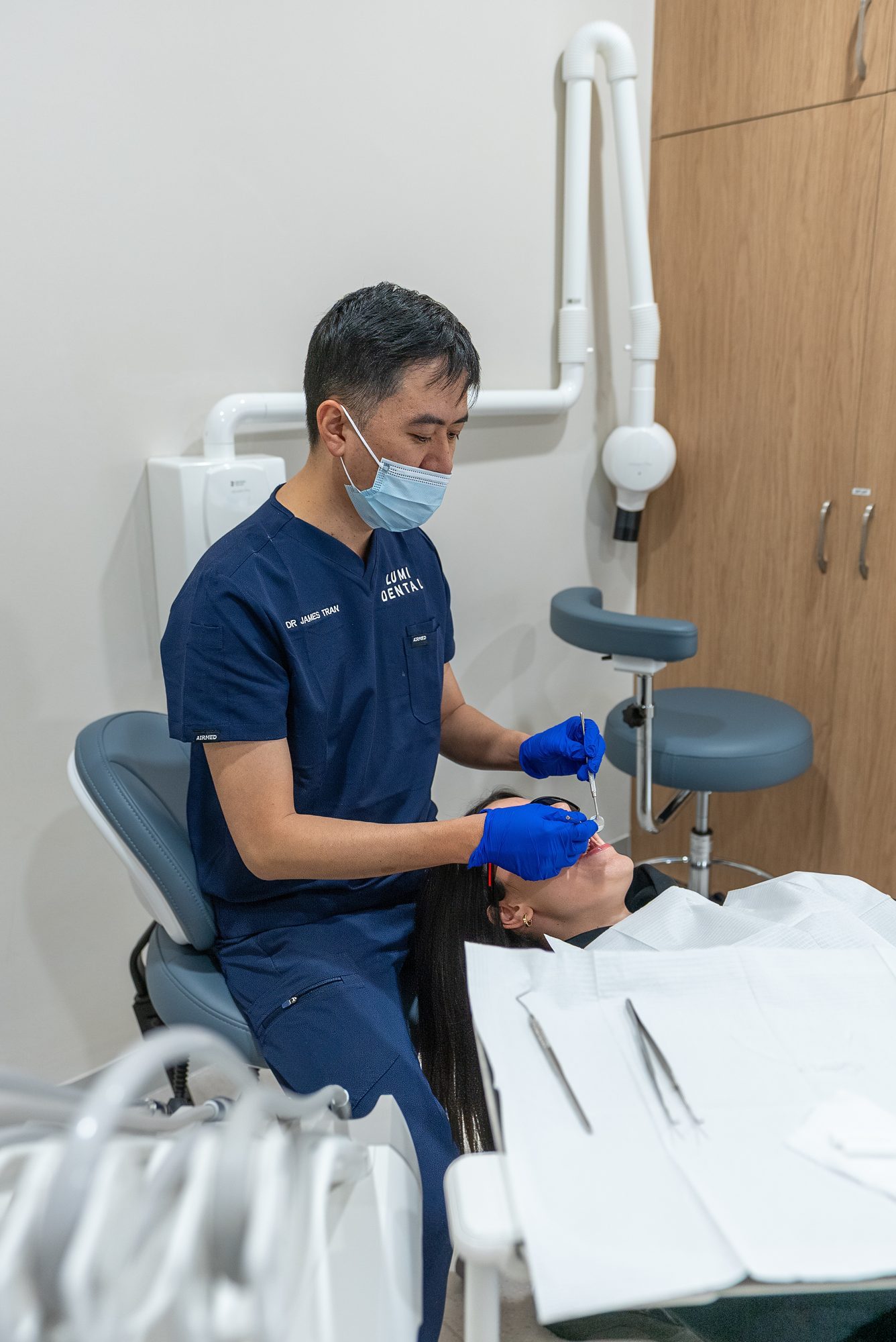
At Lumi Dental, whitening starts with an examination by a dentist, who checks the teeth and gums next to any jewellery for chips, cracks and recession, and notes fillings or bonding that will not change colour. The decision about the piercing stays with you and your piercer. Our oral health therapists can help with cleaning and gum care. The whitening options are named Lumi Home, Lumi Refresh and Lumi Radiance, and the dentist will explain which may suit you. You can read more on the teeth whitening page.
Questions patients ask
Can you get your teeth whitened with a tongue piercing?
Usually, yes. The piercing itself does not stop whitening, but the dentist checks the teeth and gums near it first, because chips and recession do not whiten.
Do I have to take out my lip ring for teeth whitening?
Not necessarily. Some people keep it in with a tray trimmed around it; others remove it or swap to a flat retainer for the session, as their piercer advises. It is a choice to discuss, not a rule.
Will whitening fix the chip from my tongue bar?
No. Whitening changes colour, not shape, so a chip stays after whitening. It is often repaired with bonding once the new shade has settled.
Can whitening gel damage my piercing?
Gel is meant to stay on the teeth, and keeping it off the gum and piercing site is part of the plan. Better Health advises against putting hydrogen peroxide on a healing piercing, one reason to wait until it has healed. If the area becomes sore during a course, stop and contact the practice.
How long after a tongue piercing can I whiten my teeth?
Wait until the piercing has fully healed. Better Health notes that oral piercings can take up to two months to heal, and some take longer.
Thinking about whitening? Complimentary cosmetic consult in Melrose Park
If you have a tongue, lip or labret piercing and would like a lighter smile, the team at Lumi Dental can check the teeth and gums near the jewellery, explain what will and will not change colour and talk through trays or an in-chair visit. Book a complimentary cosmetic consult at Melrose Central in Melrose Park, or read about teeth whitening options at Lumi Dental. Patients visit from Ryde, Parramatta, Ermington and Rydalmere, and there is on-site parking.
Sources
- Better Health Channel: Piercings
- Australian Dental Association: How mouth piercings affect teeth
- Journal of Periodontology (PubMed): Tongue piercing, impact of time and barbell stem length on lingual gingival recession and tooth chipping
- Journal of Clinical Medicine (PMC): Oral piercing in the aspect of periodontal and dental health, a narrative review
About the author

Dr James Tran is a general dentist at Lumi Dental in Melrose Park. He holds a BDent from the University of Sydney and a Graduate Diploma in Oral Implants, and is a Member of the International Congress of Oral Implantologists (MICOI).
This article is general information only and is not a substitute for an examination and individual advice from a registered dental practitioner. Suitability for any treatment varies from person to person.







