


Teeth whitening with coeliac disease is usually possible, but whitening changes the colour of a tooth, not the shape or texture of any enamel defects, so those need to be mapped first. Coeliac disease can disturb enamel while the adult teeth are forming in early childhood, leaving matching chalky, yellow or pitted areas that a whitening gel will not smooth over. Coeliac Australia estimates that more than 1 in 70 Australians are affected and that four out of five of them remain undiagnosed, so plenty of people with these marks do not yet know why they are there.
Written by Dr James Tran, BDent (University of Sydney), MICOI, GradDip (Oral Implants), general dentist at Lumi Dental in Melrose Park.
The short version
- Coeliac disease does not rule out whitening. The gel goes on the teeth for a set time and is not a food.
- The simple rule: the dentist maps any banded, chalky or pitted enamel first, then decides whether whitening alone, whitening plus resin infiltration or microabrasion, or bonding suits.
- Enamel defects that formed in childhood are permanent and do not improve on a gluten-free diet, although the rest of the tooth can still lighten.
- Chalky white patches can look brighter for a week or two after whitening, because dry enamel looks whiter.
- Coeliac UK says it is not aware of any toothpaste that contains gluten. If you want to check a product, ask for its ingredient list.
- Teeth cannot diagnose coeliac disease. Our article on coeliac disease and oral health explains the enamel pattern and why testing through your GP comes before any change to your diet.
What coeliac-type enamel defects look like
The US National Institute of Diabetes and Digestive and Kidney Diseases (NIDDK) describes coeliac-related enamel defects as white, yellow or brown spots, poor enamel formation, pitting or banding, and mottled or translucent-looking teeth. They are symmetrical and often appear on the incisors and molars. The symmetry comes from timing. Enamel forms in a set order during childhood, so a whole-body problem at that stage tends to mark matching teeth on the left and right at the same level.
Researchers usually grade these defects with Aine's classification, which runs from grade I, the mildest, to grade IV, the most severe. A systematic review in the Journal of Clinical Medicine, which looked at 18 studies, reported enamel defects in between 50% and 94% of people with coeliac disease across those studies, with symmetrical defects the most common type and mild grades seen most often. The findings are mixed: studies used different criteria, and the NIDDK notes that a US study found the link clearly in children but not a similar association in adults.
The simple rule: map the enamel before any gel goes on
If you have coeliac disease and visible marks on your front teeth, start with an examination and photographs, not a whitening kit. Whitening lightens the colour of the whole tooth. It does not fill a pit, smooth a groove or change how a chalky patch scatters light. Once the dentist knows what each mark is, the plan usually falls into one of three paths:
- Whitening alone, where enamel looks normal or marks are faint and unlikely to bother you.
- Whitening plus resin infiltration or microabrasion, where there are white or stained patches in otherwise sound enamel.
- Whitening, then bonding, where there are pits, grooves or rough areas that colour alone cannot hide.
Order matters. Bonding resin does not whiten, so if you want lighter teeth and some repairs, the whitening is usually done first and the repairs matched to the new shade once it has settled. In my experience, disappointment usually follows whitening first and noticing the marks afterwards.
Why chalky patches can look brighter for a while
Two things happen at once. The rest of the tooth gets lighter while a chalky patch, which is already pale, changes much less, so the contrast between them can shift. Whitening also dries the enamel for a short time, and dry enamel looks whiter. Porous, hypomineralised patches tend to show this most. As the teeth rehydrate over the following days, the patches often fade back towards how they looked before. Our article on why white spots show more after whitening covers this in detail, including why it is worth waiting about two weeks before judging the result.
Yellow and brown patches behave differently. Here the colour often sits inside porous enamel, and whitening can lighten it, sometimes unevenly. A small case report in Case Reports in Dentistry described whitening stained opacities first and then using resin infiltration, with partial improvement, and found it worked best once the stain was fully removed.
Matching what you see to a plan
A general guide only; many people have more than one kind of mark.
| What you see on the teeth | How whitening typically behaves | What may be added |
|---|---|---|
| White chalky bands or patches | The tooth lightens; patches can look brighter for a week or two | Resin infiltration once the shade settles, sometimes microabrasion for shallow marks |
| Yellow or brown patches | Stain in porous enamel often lightens, sometimes unevenly | Whitening first, then resin infiltration or bonding if a mark remains |
| Pits, grooves or rough areas | Colour lightens but the texture stays; may be more sensitive | Desensitising care, then tooth-coloured bonding to smooth the surface |
| Translucent or thin edges | Edges can look more see-through against lighter teeth | A gentle course; bonding if an edge is chipped or very thin |
| No visible defect | Usually behaves like any other healthy tooth | A standard whitening plan after an examination and clean |
Our article on resin infiltration for white spots explains how a fluid resin can fill porous enamel so it reflects light more like the surrounding tooth, without drilling.
Sensitivity on thin or pitted enamel
Whitening sensitivity is common in anyone, and enamel that is thin, pitted or rough may let the gel reach the inner tooth more easily. Patients I see with these defects often do better with a gentler, slower course, a desensitising toothpaste beforehand, and skipping a day if a tooth starts to zing.
Gluten in toothpaste, whitening gel and lip products
Coeliac UK explains that gluten only causes a problem for people with coeliac disease if it is eaten, and that it cannot be absorbed through the skin. It says it is not aware of any toothpaste that contains gluten, and that even if one did, it would be very unlikely that you would swallow enough to cause a reaction. On lip balm and lipstick, it says you are unlikely to swallow enough to cause a problem, and suggests contacting the manufacturer about a specific product if you are concerned.
Whitening gels and desensitising pastes are not foods either. If you would still like to check, ask the team for the ingredient list for the gel and any paste you are given. Coeliac UK also notes that sensitivity to a cosmetic ingredient has nothing to do with coeliac disease itself, so report any irritation of the lips or gums during whitening, whatever the cause.
Mouth ulcers, a sore tongue and timing
The NIDDK lists recurrent mouth ulcers, a red, smooth, shiny tongue (atrophic glossitis) and dry mouth among the oral problems related to coeliac disease. Peroxide stings on broken lining, so whitening should wait until any ulcer has fully healed. If ulcers appear after accidental gluten, move the appointment. Our guide to whitening with a mouth ulcer explains the signs that an area has healed enough.
A sore, smooth tongue or ulcers that keep coming back can point to low iron or another nutrient problem. Coeliac Australia lists iron deficiency anaemia and nutritional deficiency, along with dental enamel defects and mouth ulcers, among signs that should prompt testing for coeliac disease. That is a conversation for your GP, who decides on any blood tests and supplements. If you have not been diagnosed, Coeliac Australia advises confirming you are still eating gluten before testing so results are accurate, so do not cut gluten out first.
How we approach this at Lumi Dental
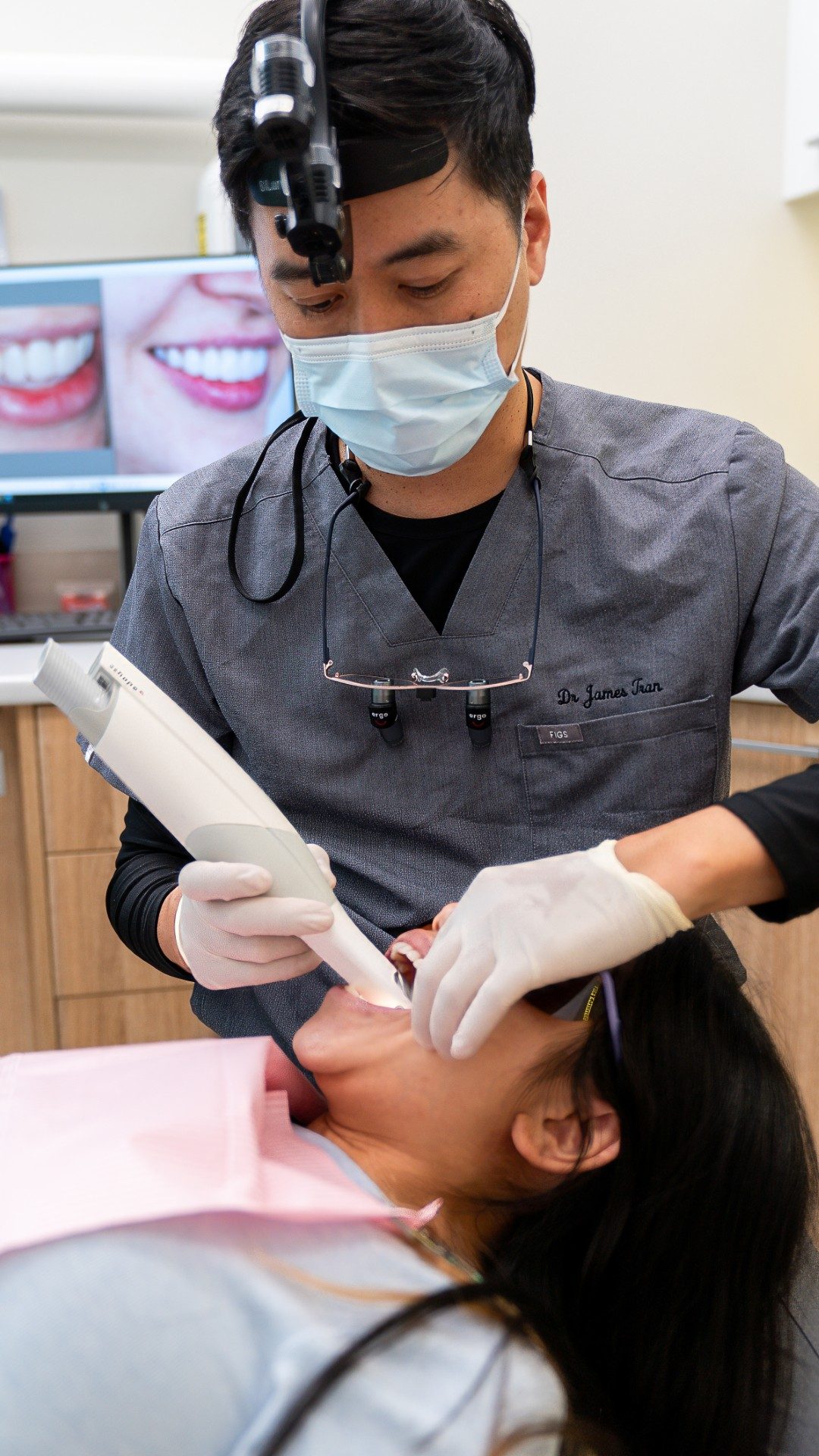
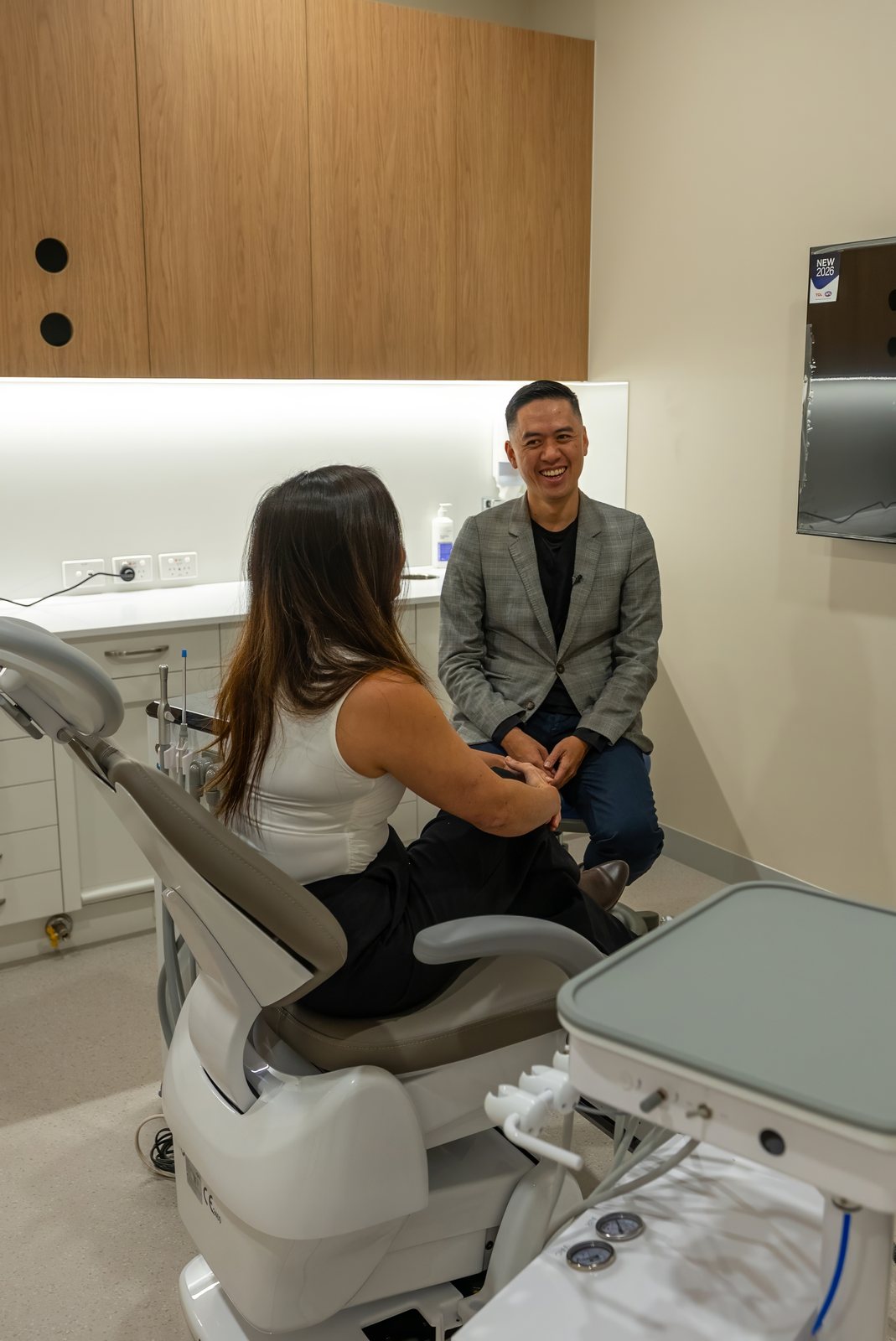
At Lumi Dental, whitening starts with an examination by a dentist, who looks at each tooth for banding, chalky patches, pits and thin edges, checks the lining of the mouth, and records the enamel with photographs before any gel is used. An oral health therapist then removes surface stain so the true shade can be read. The whitening options are named Lumi Home, Lumi Refresh and Lumi Radiance, and the dentist will explain which may suit you and whether resin infiltration, microabrasion or bonding should follow once the shade has settled. You can read about the 3D scanning and imaging used at Lumi Dental.
Questions patients ask
Can I whiten my teeth if I have coeliac disease?
Usually, yes. Coeliac disease itself does not rule out whitening. The dentist checks for enamel defects, ulcers and sensitivity first, because those shape the plan.
Will whitening get rid of the marks on my teeth from coeliac disease?
Whitening lightens the tooth but does not change pits, grooves or the texture of chalky patches. White patches may need resin infiltration, and shallow marks are sometimes suited to enamel microabrasion. Deeper defects are often covered with bonding.
Does whitening gel or toothpaste contain gluten?
Coeliac UK says it is not aware of any toothpaste that contains gluten, and gluten only causes a problem when eaten. If you would like certainty about a gel or paste, ask for the ingredient list and check with the manufacturer.
Will a gluten-free diet repair my enamel?
No. Enamel defects that formed in childhood are permanent and do not improve on a gluten-free diet. The diet treats the disease, and the teeth are looked after with dental care.
Are teeth with enamel defects more sensitive to whitening?
They can be, especially where enamel is thin or pitted. A gentler course and desensitising toothpaste often help, and our article on how long sensitivity lasts after whitening covers what to expect.
Thinking about whitening? Complimentary cosmetic consult in Melrose Park
If you have coeliac disease and would like a brighter smile, the team at Lumi Dental can examine your enamel, check your mouth for ulcers and talk through whether whitening alone or a combined plan suits you. Book a complimentary cosmetic consult at Melrose Central in Melrose Park, or read more about teeth whitening at Lumi Dental. Patients visit from Ryde, Parramatta, Ermington and Rydalmere, with on-site parking.
Sources
- Coeliac Australia: Diagnosing coeliac disease, the key facts
- Coeliac UK: Your guide to gluten
- PMC (Journal of Clinical Medicine): Celiac disease-related enamel defects, a systematic review
- NIDDK: Dental enamel defects and celiac disease
About the author

Dr James Tran is a general dentist at Lumi Dental in Melrose Park. He holds a BDent from the University of Sydney and a Graduate Diploma in Oral Implants, and is a Member of the International Congress of Oral Implantologists (MICOI).
This article is general information only and is not a substitute for an examination and individual advice from a registered dental practitioner. Suitability for any treatment varies from person to person.







