

Many people who say they "cannot wear dentures" because of gagging are reacting to one specific part of the denture: the back edge of an upper plate resting against the soft palate, or a loose plate shifting as they swallow. Change that part and the reflex often settles. When it does not, implants allow an upper denture to be made without covering the palate at all, while still staying firmly in place.
Written by Dr James Tran, BDent (University of Sydney), MICOI, GradDip (Oral Implants), general dentist at Lumi Dental in Melrose Park.
What sets the reflex off
Gagging is a protective reflex that guards the airway, triggered by touch at the back of the mouth and throat. Everyone has it to some degree, and a smaller group of people have a strong one. A 2023 systematic review in the Journal of Dentistry (Shiraz) by Mehdizadeh and colleagues looked at ways of managing gagging during dental treatment, and it is a common enough problem that dentists plan around it routinely.
Dentures bring their own triggers. An upper denture finishes near the line where the hard palate meets the soft palate. If it is thick, extends a little too far, or rocks when you bite, it touches that sensitive area every time you swallow. A lower denture rarely reaches far enough back to cause gagging, but if it is loose it can crowd the tongue, and that can set the reflex off too. There is usually a physical cause, and finding it is where treatment begins.
Why the palate is both the problem and the grip
A conventional full upper denture is held mainly by a seal around its border and suction across the palate. That is the catch: the part most likely to cause gagging is also the part that keeps the denture in. Every millimetre trimmed from the back edge or cut out of the middle costs some retention. Implants solve that conflict, because once the denture clips onto them, the palate is no longer needed for grip. That is why the options below are worked through in order, starting with the least invasive.
Small changes to the denture you already have
The first step is to check how the current denture fits. If the back edge reaches onto the moving part of the soft palate, it can be shortened. A thick palate can be ground thinner, and a bulky border can be smoothed and polished. If the denture has become loose as the gums have changed, a reline may help more than trimming, because movement is a trigger in its own right. This usually takes more than one visit, since a small adjustment changes how the denture seats.
A slimmer palate in a new denture
When a new denture is needed, it can be made with the palate as thin as practical. The Australian Dental Association notes that dentures can be acrylic alone or combine acrylic with a lightweight cobalt chrome metal, and a cast metal palate can be made considerably thinner than acrylic. For people who mainly notice the bulk of the plate, that difference can matter.
An upper denture without a palate
A palateless, or horseshoe, upper denture leaves the centre of the roof of the mouth uncovered. For many people with a strong gag reflex, that can bring relief. The trade-off is retention. Without suction, the denture depends on the shape of the ridge, the border seal and often adhesive. It tends to suit someone with a well-formed ridge whose denture fits well but who gags, rather than someone whose denture is already loose. Our explainer on horseshoe dentures goes into the trade-off.
Implants let the palate go without losing grip
An implant-retained overdenture clips onto implants in the jaw. In the upper jaw, that means the palate can be left out. A 2025 review and case series in Clinical Case Reports by Jandaghian and Zeighami reports a consensus that overdentures need at least four implants in the upper jaw and two in the lower, and notes that palateless upper overdentures on four implants may improve taste and reduce the gag reflex without reducing retention, stability or chewing. The authors also note that full palate coverage in conventional dentures has been linked with reduced taste and saliva flow.
Our guides to implant-retained overdentures and locator, ball and bar attachments explain how the clips work.
For people who cannot tolerate anything removable, a fixed full-arch bridge on four or more implants leaves the palate completely uncovered and has nothing to take out at night. It involves surgery, healing time and enough bone, and our comparison of dentures and All-on-X full-arch implants sets out the differences.
| Approach | What it changes for gagging | What it does to retention | Often suits |
|---|---|---|---|
| Adjusting the current denture | Shorter back edge, thinner palate | Similar, or better if relined | Everyone, as the first step |
| New denture with a thin or metal palate | Less bulk against the roof of the mouth | Good if the ridge is sound | People bothered by thickness |
| Palateless upper denture | Removes the main contact area | Lower; adhesive often needed | A good ridge with a strong reflex |
| Implant-retained overdenture | Palate can be left out | Held by the implants | A loose denture together with gagging |
| Fixed full-arch implant bridge | Nothing covers the palate | Fixed in place | People who cannot tolerate any plate |

Making impressions easier to tolerate
For a lot of people, the impression appointment is harder than wearing the finished denture. Some practical changes help:
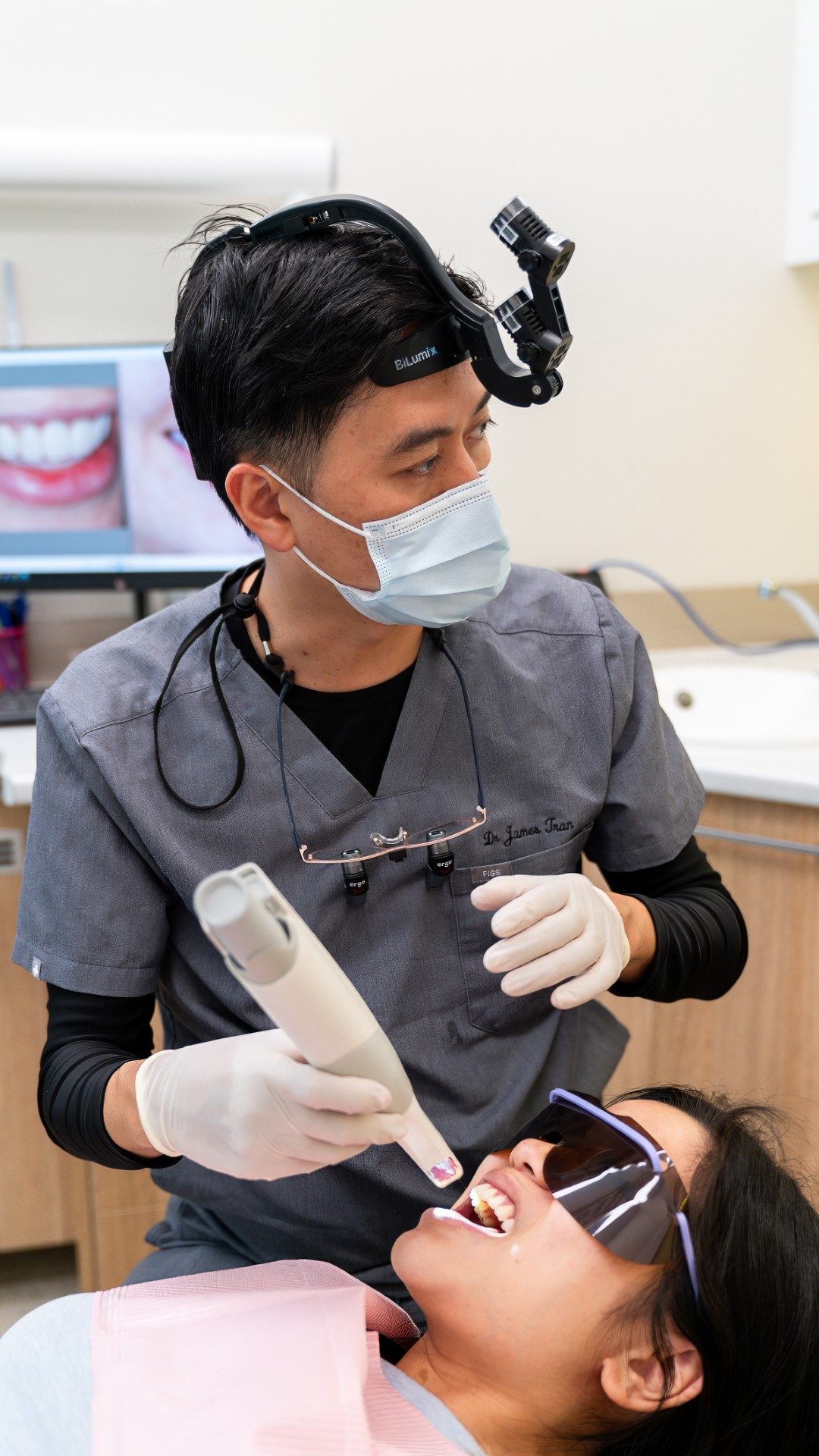
- A digital scan in place of a tray where possible. An intraoral scanner captures a small area at a time, with no impression material to run towards the throat. Our comparison of digital scans and conventional impressions explains when a tray is still needed.
- Sitting upright with the chin slightly lowered, so nothing drifts backwards.
- A shorter tray with less material when a tray is unavoidable.
- Breathing through the nose and focusing on a fixed point, a simple form of distraction.
- A thin training plate without teeth, worn at home for short periods and built up gradually, so the mouth gets used to something there.
The reflex itself can be trained
The Mehdizadeh review found that distraction techniques, nitrous oxide and low-level laser therapy were effective for managing the gag reflex during treatment. Relative analgesia (happy gas) is available at Lumi for appointments where gagging or anxiety makes treatment difficult.
For longer-term change, behavioural approaches such as gradual desensitisation, where the mouth is exposed to a little more each time, are commonly recommended. A 2025 scoping review by O'Donald and colleagues in Special Care in Dentistry found that psychological approaches such as desensitisation, relaxation and hypnotherapy generally helped, although the evidence is limited and comes mainly from case reports. Desensitisation is low risk and can be combined with a better-designed denture. Our guide to managing a gag reflex at the dentist covers the self-help side.
Things to know before choosing
A lower denture is less likely to cause gagging but more likely to be loose, because the ridge is smaller and the tongue works against it. If a denture has been trimmed at the back to reduce gagging, mention it at any later reline so the border is not built back towards the trigger area. Implant options need healthy gums, enough bone and healing time, which a 3D X-ray and examination will clarify. And any new denture takes a period of adjustment, so a fair judgement of a new design comes after it has settled and had its first adjustments.
How a gag-sensitive denture is planned at Lumi
We start with an examination to find the trigger: the length of the back edge, the thickness, the fit or the space for the tongue. Wherever possible, records are taken with our 3D intraoral scanner rather than trays, and dentures and relines are made through our in-house lab. When implants are the better path, they are planned with our Orthophos 3D X-ray and placed at the practice, including fixed All-on-X bridges. You can read more about dental implants at Lumi and the technology we use.
What patients ask about dentures and gagging
Can I wear dentures with a bad gag reflex?
Many people can. The trigger is usually the back edge, the bulk or the movement of an upper denture, and each of these can be reduced through adjustment, a thinner or palateless design, or implants.
How many implants does a palateless upper denture need?
The consensus reported in the Clinical Case Reports review is at least four in the upper jaw. The right number for you depends on your bone, which a 3D X-ray shows.
Why do I gag on my top denture but not my bottom one?
The upper denture reaches back towards the soft palate and the lower one does not. A loose lower denture can still cause gagging by crowding the tongue, but that is a fit problem rather than a palate problem.
Will it get better with time?
Often, if the fit is right and the reflex is gradually trained. If there is no improvement after the first adjustments, changing the design is the next step.
Gagging on your denture?
A consultation is the place to find the trigger, adjust what you already have and find out whether a palateless or implant-retained denture suits your jaw. Contact Lumi Dental in Melrose Park to arrange a free implant consult, or read about full-arch implants at Lumi, where nothing covers the palate.
Sources
- Jandaghian and Zeighami, Clinical Case Reports 2025: Palateless maxillary implant-supported overdentures, a review of patient satisfaction and clinical outcomes along with case series
- Mehdizadeh and colleagues, Journal of Dentistry (Shiraz) 2023: An overview about new methods in management of gag reflex during dental treatment, a systematic review
- O'Donald and colleagues, Special Care in Dentistry 2025: Psychological interventions for gagging, implications for dental practice
- Australian Dental Association (teeth.org.au): Dentures
About the author

Dr James Tran is a general dentist at Lumi Dental in Melrose Park. He holds a BDent from the University of Sydney and a Graduate Diploma in Oral Implants, and is a Master of the International Congress of Oral Implantologists (MICOI).
This article is general information only and is not a substitute for an examination and individual advice from a registered dental practitioner. Suitability for any treatment varies from person to person.








