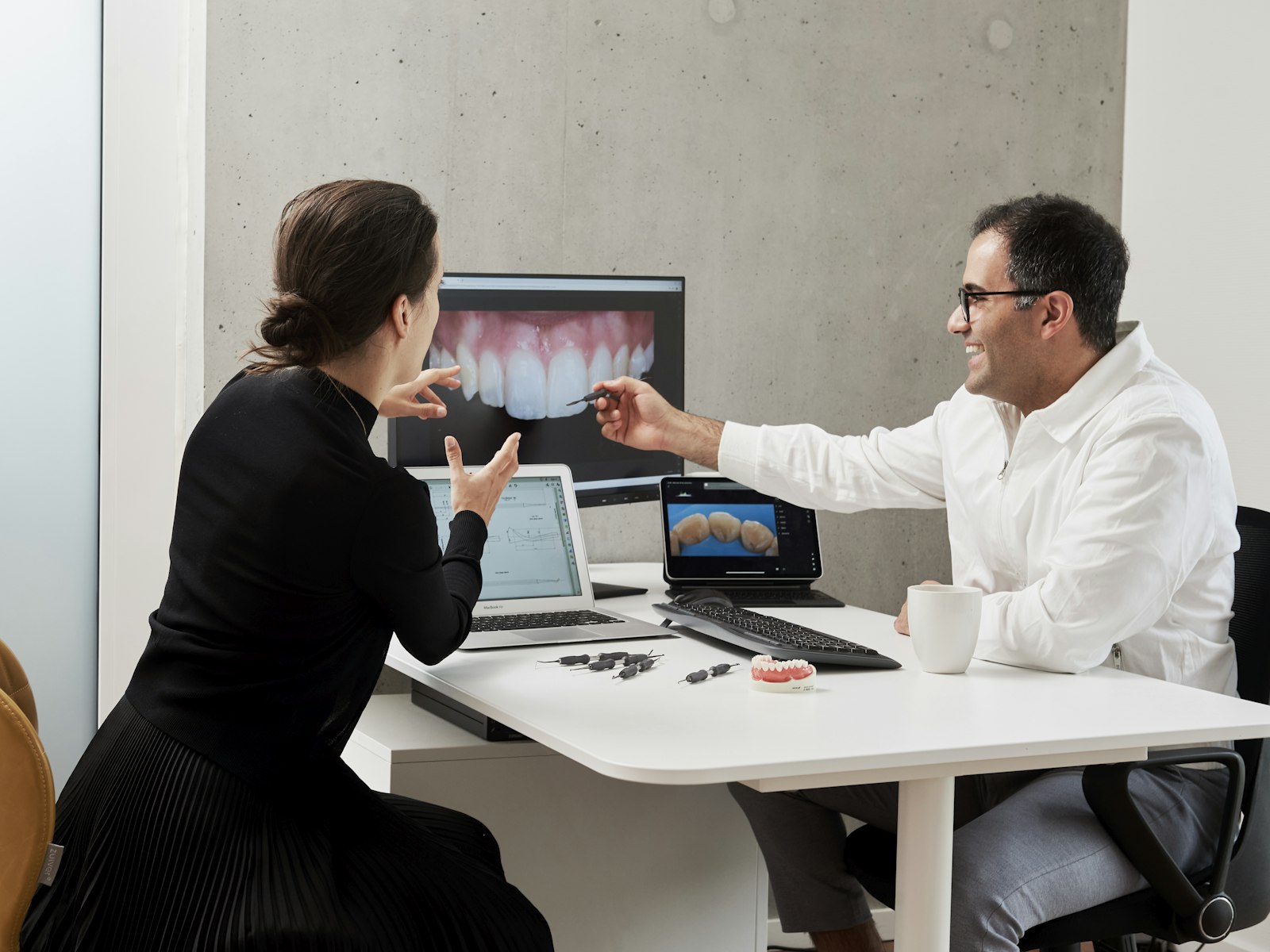

If a photo a friend took makes your smile look lopsided, but the bathroom mirror never does, your teeth have not moved. The two images are reversed versions of each other. Every measurement in them is the same; only the side each small asymmetry sits on has swapped, and the version you know best is the mirrored one.
That one idea explains a lot of photo shock. It also gets confused with a second, unrelated effect, which is what a close-up wide-angle lens does to the shape of a face. This article separates the two and suggests a simple way to test which one is bothering you.
A reversed image keeps every proportion the same
Strictly speaking, a flat mirror does not swap left and right. It reverses the image front to back, and we read the result as a left-right swap because we imagine turning around to stand where our reflection is. Either way, the practical point holds: a reversal is a perfect geometric copy with opposite handedness.
So if the line of your front teeth tilts by a degree, it tilts by the same degree in both versions. If one gum line sits half a millimetre higher, it does so in both. Flipping a photo cannot make a smile more crooked or a tooth larger. It can only move the asymmetry to the other side.
The selfie preview and the saved photo may not match
Front cameras usually show a mirrored live preview, because that feels natural when you are lining up a shot. What gets saved can be different, and phone makers let you choose.
Apple's iPhone user guide says that to take a mirrored selfie that captures the shot as you see it in the front camera frame, you turn on Mirror Front Camera in Settings, then Camera (older models call it Mirror Front Photos). With that setting off, the saved selfie is the non-mirrored view, the way other people see you.
Google's Pixel Camera help says selfies can be saved as mirrored or non-mirrored photos, and that a selfie saved as previewed will not appear reversed after you take it. The option is under the down arrow at the top of the camera, then Settings, then Save selfie as previewed.
Other brands and social media apps handle this in their own ways and do not always document it. The quickest check is to take a selfie while holding something with writing on it. If the writing reads normally in the saved photo, the file is the non-mirrored view; if it is backwards, the file kept the mirrored preview.
Why the mirrored face feels more like you
In 1968 the psychologist Robert Zajonc published work in the Journal of Personality and Social Psychology showing that repeated exposure to something tends to make people like it more, an idea known as the mere exposure effect. You have seen your reflection thousands of times and your true orientation far less often.
Mita, Dermer and Knight applied this idea to faces in 1977, in a paper titled "Reversed facial images and the mere-exposure hypothesis". The finding has since been retested. Suchow and colleagues, writing in Perception in 2024, asked people to rate photos of themselves and of close friends. Non-reversed photos of one's own face were rated as less like oneself and less pleasant than reversed ones, and the pattern disappeared for friends, whose non-reversed face is the familiar one. Their first experiment was replicated seven years later. The authors suggest the effect comes from a strong but adaptable mental picture of oneself, which is jolted when an unfamiliar view exposes facial asymmetries.
A study of 214 women in a plastic surgery department, published by de Runz and colleagues in the Journal of Plastic, Reconstructive and Aesthetic Surgery in 2016, found that 73% preferred the mirror-reversed photo of themselves, rising to 84% among those having facial aesthetic surgery.
The research does not all point one way
Some studies complicate the familiarity story. Al-Bitar and colleagues, in Maxillofacial Plastic and Reconstructive Surgery (2023), showed dental students their own photos and mirror images without saying which was which. For standardised frontal photos taken by an investigator, most students preferred the true image of themselves. For their own smartphone selfies, most preferred the mirror image. They also preferred the true image of a volunteer they did not know.
Wen and Kawabata, in i-Perception (2014), found that people tended to pick slightly altered photos of themselves, with bigger eyes or smaller mouths, as their real face, while correctly picking unaltered photos of classmates. In their third experiment, swapping in mirror-reversed self-photos made no difference to those choices.
So reversal does change how familiar and likeable your own face seems, but it is one influence among several, and it does not behave identically in every study.
Small asymmetries stand out when the familiar template is gone
Almost every smile is a little asymmetric. Chaptini and colleagues, in the American Journal of Orthodontics and Dentofacial Orthopedics (2025), used eye tracking with 195 orthodontists, dentists and members of the public to find how large a change in a digitally altered smile had to be before it drew attention. A higher gum line on one central incisor was noticed at 1 mm by dental professionals and 1.5 mm by laypeople. A difference in the width of the lateral incisors had to reach 2 mm for orthodontists, 3 mm for dentists and 4 mm for laypeople before it was noticed. The authors concluded that more attention goes to gum asymmetries close to the midline and to tooth changes that alter the curve of the smile.
Those findings come from comparing images side by side. Day to day, you only ever see one orientation, so small differences, such as a slightly off-centre midline or a lip that lifts more on one side, become part of the face you expect. Reverse the image and the expectation no longer fits, so the difference suddenly seems obvious. Nothing has changed in size. Our articles on the smile midline and on facial asymmetry and a crooked-looking smile look at those features in more depth.
Lens distance changes shape; flipping does not
This is the separate effect that often gets blended in. A camera held at arm's length makes whatever is closest to it, usually the nose and mouth, look larger relative to the rest of the face.
Ward and colleagues, in JAMA Facial Plastic Surgery (2018), built a mathematical model of this. It was a geometric calculation using average face measurements, not a study of real photographs. The model estimated that at about 30 cm (12 inches) the nose appears roughly 30% larger in men and 29% larger in women than in a distortion-free projection, and that at about 1.5 m (5 feet) there is essentially no difference. Nobody has published an equivalent figure for teeth, so that number should not be applied to a smile.
Measured studies point the same way. Třebický and colleagues, in PLoS ONE (2016), photographed 45 people at focal lengths of 50, 85 and 105 mm and had 369 raters compare them; the 50 mm photos were rated less attractive, and focal length measurably changed the depicted shape of the face. Derakhshan and colleagues, in The Laryngoscope (2024), compared a smartphone and a full-frame camera at several distances and found facial distortion when photos were taken very close with short focal lengths.
Front-facing phone cameras are wide-angle and are usually used at arm's length, which is close to the worst case for this kind of distortion. Clinical dental photography uses longer macro lenses at a controlled distance for this reason.
| What changes | Caused by the flip | Caused by distance and lens |
|---|---|---|
| Which side an asymmetry is on | Yes | No |
| Relative size of nose, lips and teeth | No | Yes, more at close range |
| Overall face shape and width | No | Yes, with wide-angle lenses |
| Apparent tilt of the smile | No (same tilt, opposite side) | Only through head angle and pose |
Head tilt, side lighting, a lopsided expression and how the photo is cropped can also make a level smile look uneven. Our articles on why teeth look different in photos, why teeth look different in the mirror and teeth on video calls cover those factors, and ring light colour temperature deals with how lighting shifts tooth shade.
A fairer test you can do at home
To compare like with like, use the rear camera and have someone else take the photo, or use a timer on a steady surface. Stand about 1.5 m away. Keep your head level, using a door frame or shelf behind you as a horizontal guide, and face soft, even light. Take one photo with relaxed lips and one with a full smile. Then open the photo, use the edit tool to flip it, and look at both versions.
Often the stretched look turns out to have come from the short distance, and an asymmetry that looked striking one way round looks ordinary the other way, because it is the same size in both. Neither image is the definitive you. Both are flat, frozen captures of a face that other people see moving, from many angles and in changing light.

What patients ask about flipped photos
Is the mirror or the camera more accurate?
Neither is more accurate about size or angle, because a reversal preserves geometry. The rear camera, from a reasonable distance, shows the orientation other people see. The mirror shows the one you are used to.
Why does an inverted filter make my face look uneven?
It removes the orientation you are used to, so asymmetries that normally go unnoticed become easier to see. They are no bigger than before.
Is my smile actually crooked or is it the photo?
A flip cannot create a crooked smile, but head tilt, crop, lighting and close lens distance can make a level one look uneven. A dental assessment with standardised photos, taken with the head in a natural, level position, is the reliable way to check.
Why do dentists take their own photos?
Because phone selfies vary in distance, lens, lighting and mirroring. Consistent clinical photos make it possible to compare like with like over time.
If something in your photos keeps catching your eye, a free cosmetic consult at Lumi Dental in Melrose Park includes standardised photographs taken in our clinical photo room, so you have a consistent view to discuss. You can arrange a free cosmetic consult or see our current offers. We are open Monday to Saturday.
This article is general information only and is not a substitute for an examination and individual advice from a registered dental practitioner. Nothing here suggests that an asymmetry visible in a photograph indicates a clinical problem, and individual suitability for any treatment varies.