

Many people keep playing a wind or brass instrument with dentures or dental implants, but the teeth need to be planned with the mouthpiece in mind, because the front teeth, the lip support behind them and the plate over the palate all shape your embouchure. Embouchure is the use of the lips, facial muscles, tongue and teeth to play a wind instrument. Research on players with dentures or implants is limited to a handful of case reports, so most of what helps is practical.
Written by Dr James Tran, BDent (University of Sydney), MICOI, GradDip (Oral Implants), general dentist at Lumi Dental in Melrose Park.
The short version
- Brass, single reed, double reed and flute players load the front teeth and lips in different ways, so the right design depends on what you play.
- A loose upper denture can shift under mouthpiece pressure. Adhesive may help in the short term, but it does not fix a poor fit.
- The plate over the palate helps hold a full upper denture in place, yet it can also change tonguing and the feel of the air. A palate-free upper design usually needs implants.
- The single rule: bring your instrument, or at least your mouthpiece, to the planning appointments, before the final teeth are made.
- Our article on wind and brass players, teeth and bite covers natural teeth and braces; this one is about dentures and implants.
What brass, reed and flute players ask of the front teeth
- Brass (trumpet, horn, trombone, tuba): the sound comes from the lips buzzing into the mouthpiece. The rim presses on the lips, with the front teeth just behind them.
- Single reed (clarinet, saxophone): the reed rests on the lower lip over the lower teeth, and the upper front teeth sit on the mouthpiece.
- Double reed (oboe, bassoon): there is no mouthpiece. The reed sits directly on the lips.
- Flute: the lower lip lies along the embouchure hole, just short of its edge, and the player blows across it, with no mouthpiece pressing on the lips.
There is some agreement on one point: no single embouchure suits everyone, because tooth position, lip shape and jaw shape differ from person to person.
How much load goes through one front tooth
A single-player study from the University of Porto placed pressure sensors on a saxophone mouthpiece. In that one player, the average force on one upper central incisor was about 72 g, compared with about 8 g on the tooth beside it, and the force rose on lower notes. It is one player, but it suggests one tooth can carry most of the load.
Why a loose upper denture moves under mouthpiece pressure
A full upper denture is held by suction and a close fit. A mouthpiece pushes on the front teeth, in front of the ridge, and that leverage can tip the denture or break the seal at the back. In a case report of a professional oboist, the authors described the provisional removable plate as less stable than the later implant crown, possibly because it moved under mouthpiece pressure.
Patients I see who play brass often notice this first on loud or high passages.
Adhesive as a stopgap
Denture adhesive can steady a denture for a rehearsal or a performance while a reline or new denture is being planned. It is a short-term aid rather than a fix: if you need more and more adhesive, the fit has changed and the denture needs checking. Our guide to denture adhesives explains how to use them.
Palate cover, air and tonguing
The acrylic plate over the roof of the mouth does much of the holding for a full upper denture, and it sits where the tongue works when you articulate notes. In the oboist case, a thick acrylic base was linked with poorer tonguing control, which improved once the base was trimmed.
Leaving the palate open is possible with healthy natural teeth to clip onto, or with implants. Our article on palateless upper dentures sets out when a horseshoe design is realistic.
The single rule: bring your instrument to the planning appointments
If you play a wind or brass instrument and are about to have new dentures, an implant crown or a full-arch bridge made, bring the instrument, or at least the mouthpiece and reed, to the planning and try-in visits. Front tooth position, lip support and palate cover can be set with playing in mind while the teeth are still in wax or temporary form.
In the oboist case, the provisional implant crown was adjusted while she played in the clinic, and the final crown was made in the shape of that adjusted provisional. At eight years she reported no change when playing.
Copy what already works
If your current teeth suit your playing, record them first:
- A copy of your existing denture as a starting point for tooth position and lip support.
- Photos of your smile and of your embouchure while playing.
- A 3D scan of the edges and angles the mouthpiece rests on.
I usually ask players to play a few long notes and a short articulated passage at the try-in.
Implant options for players compared
None of these options has been studied in groups of musicians, so treat this table as a guide to trade-offs, not evidence.
| Option | Stability under mouthpiece pressure | Palate cover | What players often notice |
|---|---|---|---|
| Full upper denture | Relies on suction; can tip with front pressure | Full plate | Changes in tonguing and air feel; may need adhesive |
| Implant overdenture (clips onto implants) | Firmer; still removable | Can often be reduced or left open with enough implants | Flange gives lip support; small movement on the clips is possible |
| Fixed full-arch bridge (All-on-X at Lumi Dental) | Fixed to implants; does not move | None | Possible air escape or lip support gaps where gum and bone have been lost |
| Single front implant crown | Fixed; carries the load of one tooth | None | Edge shape and angle can change how the mouthpiece sits |
Implant overdenture
An overdenture clips onto two or more implants. It keeps a flange that can support the lips where bone has shrunk, and it lifts out to clean. Our article on overdenture attachments, from locators to bars compares the clip types.
Fixed full-arch bridge
A fixed bridge does not move and has no palate plate. The trade-off is lip support. A case report from Tokyo described a 55-year-old amateur saxophonist who tired early and lost embouchure stability after a fixed full-arch bridge; there was a space between the bridge, gum and cheek, and air leaked to the side. A removable acrylic splint worn only while playing filled that space, and his comfort and long-note duration improved. It is a single case, but a reason to check lip support with the instrument before a bridge is finished. At Lumi Dental the fixed full-arch service is called All-on-X full-arch implants.
A single front implant crown
For one missing front tooth, an implant crown avoids cutting the neighbouring teeth. Because one front tooth may carry much of the mouthpiece load, its edge and angle matter, and a provisional crown lets you test them first. Our guide to a front tooth dental implant explains the steps.
Air escape and the adjustment period
New teeth change the space your tongue and air move through, so speech and playing often need a period of adjustment. Small changes to the back of the teeth or the gum line can reduce air escape once the cause is clear. Our article on speaking with a new full-arch implant bridge covers air escape in more detail.
Keep notes on which notes or dynamics feel different. That makes each adjustment visit more useful.
Returning to play after implant surgery
There is no agreed timetable for wind players after implant surgery. The dentist or surgeon who placed the implants is the one to clear you, based on the surgery, any grafting and whether temporary teeth were fitted.
If a performance is coming up, raise it at the consult so surgery can be timed around it.
How we approach this at Lumi Dental
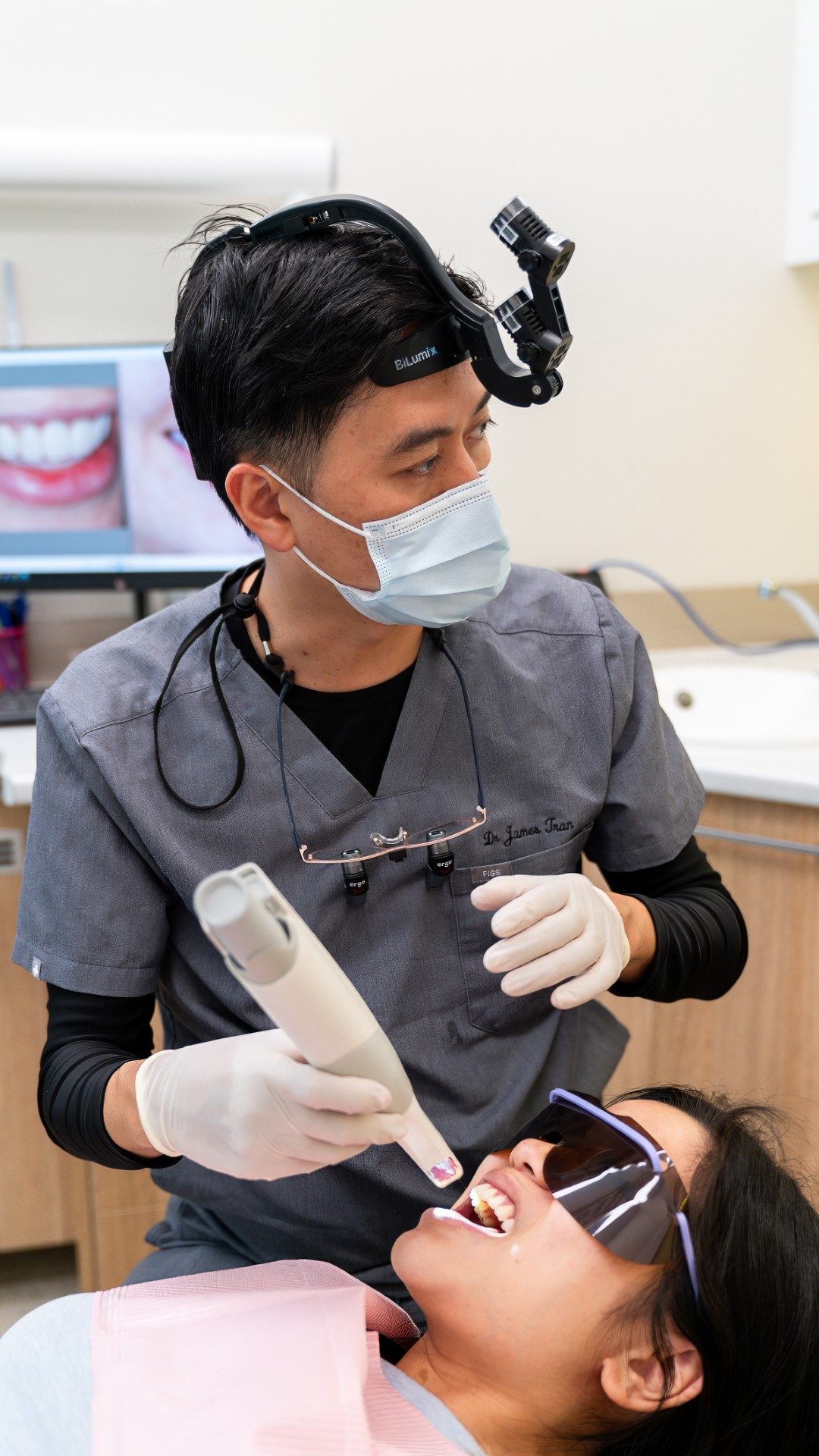
At Lumi Dental in Melrose Park, a dentist examines your mouth, takes a 3D X-ray and a 3D scan in house where needed, and talks through dentures, implant overdentures, single implants and All-on-X full-arch bridges. Tell the team what you play and how often, and bring the instrument or mouthpiece to the planning and try-in visits so tooth position and lip support can be checked while you play. Lumi Dental does not offer music-specific services; complex cases are referred to a registered specialist. Read more about dental implants at Lumi Dental.
Questions patients ask
Can you play the trumpet with dentures?
Many people do, though it usually takes practice to adapt. If the denture moves under mouthpiece pressure, ask about a reline or implants.
Are dental implants better than dentures for playing the saxophone?
Implants give a steadier base, but no research compares the two in musicians. A fixed bridge can leave gaps in lip or cheek support, so it should be tested with the instrument before it is finished.
Will an implant crown on my front tooth change my embouchure?
It can, because the edge shape and angle of a front tooth affect how the mouthpiece sits. A provisional crown lets you play on it and adjust it first.
How soon can I play after implant surgery?
Ask the dentist or surgeon who placed the implants. There is no fixed time that suits everyone.
Should I bring my instrument to the dentist?
Yes, for planning and try-in visits. Playing a few notes in the chair shows how the teeth, lips and palate work together. Contact Lumi Dental if you are unsure which visit to bring it to.
Considering implants or new dentures? Complimentary implant consult in Melrose Park
If you play a wind or brass instrument and are thinking about new dentures or implants, the team at Lumi Dental can examine your mouth, scan your current teeth and plan with your playing in mind. Contact Lumi Dental to book a complimentary implant consult, or read more about dental implants in Melrose Park. Patients visit from Ryde, Parramatta, Ermington and Rydalmere, with on-site parking at Melrose Central.
Sources
- Wikipedia: Embouchure
- Clemente M and colleagues: A Prosthodontic Treatment Plan for a Saxophone Player, a Conceptual Approach (PMC)
- Frontiers in Psychology (Hattori M and colleagues): Dental treatment for an oboist, post-trauma prosthetic rehabilitation and evaluation of musical performance (PMC)
- Frontiers in Dental Medicine (Hattori M and colleagues): Fabrication of a plumper-type music splint for saxophone performance in a patient with a full-arch implant-supported prosthesis (PMC)
About the author

Dr James Tran is a general dentist at Lumi Dental in Melrose Park. He holds a BDent from the University of Sydney and a Graduate Diploma in Oral Implants, and is a Member of the International Congress of Oral Implantologists (MICOI).
This article is general information only and is not a substitute for an examination and individual advice from a registered dental practitioner. Suitability for any treatment varies from person to person.







