

If you play contact sport with dentures or a partial denture, ask your dentist whether the denture should come out for play and what mouthguard suits your mouth as it is during the game. Sports Medicine Australia states that wearing a mouthguard can reduce the risk of dental injuries by more than half. Playing sport with dentures adds a second question: what happens to the denture itself in a hard knock.
Written by Dr James Tran, BDent (University of Sydney), MICOI, GradDip (Oral Implants), general dentist at Lumi Dental in Melrose Park.
The short version
- For contact sport, the usual approach is to take the denture out and wear a mouthguard made for your mouth without it, but your dentist decides what suits you.
- A guard bought off the shelf is not designed to be moulded over a removable denture; if a partial is to stay in, the dentist designs the guard around it.
- People with no natural teeth can still benefit from a guard in contact sport, because a blow to the chin can force the jaws together.
- Keep the denture in a labelled hard case during play, not in a pocket or a tissue.
- Our guide to custom versus boil-and-bite sports mouthguards explains the three types of guard.
Why a denture changes the mouthguard question
Sports Medicine Australia lists basketball, football, hockey, martial arts and boxing among the sports with the highest risk of dental injuries, and notes that an indirect blow, such as a hit to the chin forcing the teeth together, is one way they happen. The Better Health Channel reports that cycling, skateboarding and scooter riding account for about 44 per cent of dental injuries, so contact sport is not the only concern.
A denture adds two problems. It can break, and a broken piece or a whole partial can end up somewhere it should not be. It also changes what a mouthguard has to fit, because your mouth is a different shape with the denture in and out. Our article on dental implants and contact sport covers fixed implant teeth; this one is about dentures you can take out.
The single rule: for contact sport, ask whether the denture comes out
If knocks to the face are part of your sport, ask your dentist whether to take the denture out and wear a mouthguard made for your mouth as it is during play. Avoid fitting a boil-and-bite guard over a removable denture at home: it may not seat properly and can hold the denture loosely in place.
In my experience, many people who play sport with a denture have never been asked how they manage it on game day. A short conversation at a check-up usually sorts it out.
Full dentures: out for play, with a guard for the gums
People with a full denture often take it out for contact sport. That avoids a cracked or loose denture in a collision, but leaves the jaws without the support of teeth.
The American College of Prosthodontists addresses this in its position statement on mouthguards. It states that people with no natural teeth also need a mouthguard if they are not wearing their dentures during competition, because a hit to the chin is likely to force the lower jaw to over-close, which may fracture part of the jaw. It suggests a single-layer guard made to fit over the gums at a slightly open bite.
Partial dentures: two ways to design the guard
A partial denture sits alongside natural teeth, often held by clasps around some of them. Those teeth still need protecting, and clasp teeth can take extra strain in a knock.
The same position statement describes two options. A guard can be made with the partial denture in place, or the dentist may make it to fit with the partial removed, to reduce the risk of injury from the clasps or cut down the number of appliances worn during play. The choice depends on how many teeth you have, where the gaps are and how firmly the partial sits. Metal-framed, acrylic and flexible partials differ, but none is designed to take a direct blow.
Sport by sport: denture in or out
The table is a starting point for a conversation with your dentist, not a rule for every mouth. The Australian Dental Association and Sports Medicine Australia encourage clubs to adopt a mouthguard policy, so check your club's rules too.
| Sport or situation | Denture in or out (to discuss) | Mouthguard approach to discuss |
|---|---|---|
| Rugby union or rugby league | Usually out | Custom guard over the remaining teeth, or over the gums for a full denture wearer |
| AFL or soccer | Usually out for matches | Custom guard; collisions and falls are part of the game |
| Hockey or martial arts | Usually out | Custom guard plus any face protection the sport requires |
| Cycling, mountain biking or skating | Often worn if it fits securely | Ask whether a guard suits off-road riding or skating, where falls are common |
| Gym and weights | Often worn if secure | A guard is not usually needed |
| Social netball or basketball | Often out, especially a partial | Custom guard; elbows and falls cause many knocks |
| Swimming | Often worn for lap swimming if secure | Treat water polo as a contact sport |
Where the denture goes while you play
A denture taken out at the ground is easy to lose and easy to break. Keep it in a hard case with your name on it, in a zipped part of your bag, and put it back in once you are off the field and have rinsed your mouth. If you rely on one denture, our guide to spare and copy dentures explains how a spare is made.
Adhesive can help a well-fitting denture feel more secure for non-contact activities, but it does not make it safe to wear a denture where the dentist has advised taking it out. Needing more adhesive than usual often means the fit has changed.

What to do after a knock
Once any head injury has been assessed by the trainer or first aider, check your mouth and the denture:
- Count the pieces. Are any teeth, clasps or chips missing?
- Look at the plate. A fine crack tends to get worse with use.
- Check your clasp teeth. A natural tooth that feels loose or sits differently needs a dentist to look at it.
- Feel for sore spots where the denture was pushed into the gum.
- Look for a knocked-out natural tooth. Our guide to first aid for a knocked-out tooth covers the first hour.
If a piece is missing
A partial denture or a broken piece can be swallowed or breathed into the airway. A review by Daniels and colleagues identified 85 such patients from 77 published case reports. Complications were documented in 37.6 per cent, and symptoms lasting more than a day or removal delayed beyond four days were linked with more complications. Case reports tend to collect the cases that went badly, so this does not show how likely harm is, but it does show that speed matters.
If part of a denture cannot be found, do not assume it fell on the grass. If you are coughing, wheezing, short of breath or cannot swallow, call Triple Zero (000). If you feel well but a piece is missing, seek medical assessment the same day and take the rest of the denture with you.
If the denture is cracked
Keep all the pieces, avoid household glue, and book a repair. Our article on what to do with a broken denture explains how different breaks are repaired. For a painful injury to a natural tooth, the team offers emergency dental appointments.

Implant overdentures and stability
A denture that clips onto implants is often more stable than one resting on the gums alone, which some people find helpful for running, cycling or the gym. For contact sport, the same question still applies. Our guide to implant-retained overdentures explains who they tend to suit. I usually suggest mentioning your sport early in an implant consult, because it can affect the design.
How we approach this at Lumi Dental
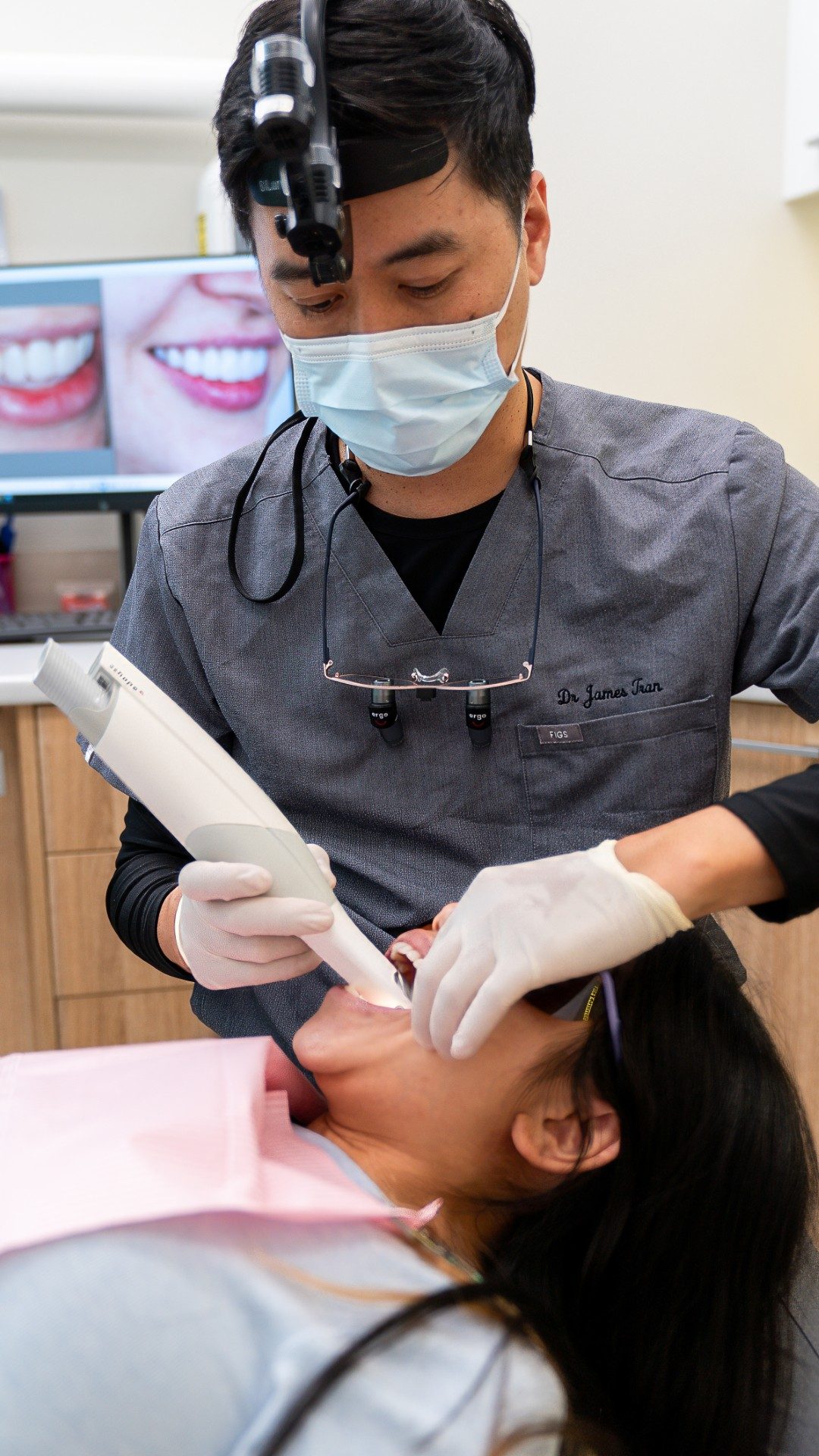
At Lumi Dental, a dentist examines your mouth, your denture and the teeth that support it before recommending a mouthguard approach. Custom sports mouthguards are made from an impression or a 3D intraoral scan taken in house. The team also carries out denture checks, repairs and relines, and implant overdentures are available after an examination and 3D X-ray. Specialist cases are referred to registered specialists. Read more about dental implants at Lumi Dental.
Questions patients ask
Can I wear my dentures while playing football?
It depends on the code and how your denture fits. For tackling codes, the usual approach is to take the denture out and wear a mouthguard made for your mouth without it, so ask your dentist what suits you.
Can I wear a mouthguard over my partial denture?
Only if the dentist designs the guard with the partial in place. A store-bought guard moulded over a partial at home may not fit properly.
Do I need a mouthguard if I have no teeth?
For contact sport, it is worth asking. The American College of Prosthodontists recommends a simple guard over the gums for people playing contact sport without dentures, because a blow to the chin can force the jaws together.
What should I do if my denture breaks during a game?
Collect every piece and do not glue it yourself. If a piece is missing, follow the steps above. Our guide to broken dentures covers repairs.
Is denture adhesive enough to keep my denture in during sport?
Adhesive can help with non-contact activities, but it is not a substitute for taking the denture out when your dentist has advised that. Needing more of it is a good reason to book a denture check.
Playing sport with dentures? Book a denture check or complimentary implant consult in Melrose Park
If you play sport with a full or partial denture, a denture check is a chance to talk through whether it should stay in or come out, and what mouthguard suits you. Contact Lumi Dental to book, or read about a complimentary implant consult on our dental implants page if you are considering a more stable option. Patients visit from Ryde, Parramatta, Ermington and Rydalmere, with on-site parking at Melrose Central.
Sources
- Sports Medicine Australia: Sports Dental Injuries
- Better Health Channel: Mouthguards
- American College of Prosthodontists: Position Statement, Mouthguard Use in Sports
- Ear, Nose and Throat Journal (Daniels and colleagues): A 10-Year Review of the Complications Caused by Ingested and Aspirated Dentures (PubMed)
About the author

Dr James Tran is a general dentist at Lumi Dental in Melrose Park. He holds a BDent from the University of Sydney and a Graduate Diploma in Oral Implants, and is a Member of the International Congress of Oral Implantologists (MICOI).
This article is general information only and is not a substitute for an examination and individual advice from a registered dental practitioner. Suitability for any treatment varies from person to person.







