

If you are planning a gum graft, whitening is usually best done before the surgery; if the graft is already done, wait until the periodontist who placed it says it has matured, which research suggests is often a matter of months rather than weeks, and then whiten with custom trays made after healing. Peroxide gel can irritate gum, and a fresh graft is a healing wound. A small human study found grafted connective tissue had integrated with the surrounding gum at about 2 months, which is a sensible earliest point to start the conversation about teeth whitening after a gum graft.
Written by Dr James Tran, BDent (University of Sydney), MICOI, GradDip (Oral Implants), general dentist at Lumi Dental in Melrose Park.
The short version
- The simple rule: whiten before the graft if you can. If not, wait until the periodontist clears it, then whiten with trays made after healing.
- A graft is a healing wound for weeks. Strong peroxide gel can burn gum tissue, so it stays well away from a new graft.
- Exposed root surface whitens less evenly than enamel. Our article on whitening with receding gums explains why.
- Trays made before surgery follow the old gum line and may press on or leak gel onto the graft margin.
- Roots that are still partly exposed after the graft can be more sensitive during whitening.
- Whitening changes tooth colour only. It does not change the colour of the gum or the graft.
Why peroxide and a fresh graft do not mix
Teeth.org.au, the Australian Dental Association's consumer site, warns that strong hydrogen peroxide gel touching the gums, lips or tongue can cause chemical burns that often turn into ulcers before they heal. Healthy gum usually recovers from a brief touch of gel. A new graft is different: it is a piece of tissue that is still forming a blood supply and attaching to the root and surrounding gum.
A review of at-home bleaching notes that gum irritation with tray whitening is often related to the shape of the tray or the strength of the gel. Around a graft, both matter more than usual. Even mild irritation at the graft edge is something a periodontist would rather avoid while the tissue settles. Our article on gum irritation after teeth whitening covers how that irritation looks on healthy gum.
The simple rule: whiten first if you can, otherwise wait for clearance
If whitening is on your list and the graft has not been done yet, whitening first is often the simpler order. The gum is intact, the trays fit the current gum line, and any sensitivity can settle before surgery. Tell the periodontist you have whitened, and leave a gap so your teeth are comfortable going into the procedure.
If the graft has already been placed, the person who did the surgery is the one who clears whitening. They have seen the tissue, know which technique was used and will check how it has healed at review. In my experience, most people are happy to wait once they understand that whitening can be done at any time, while a graft only gets one chance to heal well.
How long graft healing takes
Healing times vary with the technique, the size of the graft, smoking and general health, so the figures below are a guide from research rather than a schedule for your mouth. Our article on gum graft recovery covers the day-to-day side of the first weeks.
The first weeks: blood supply and attachment
In an animal study of connective tissue grafts, the graft was fully supplied with blood vessels at 14 days, the attachment at the gum edge had formed by 28 days, and the surface lining looked normal again at 60 days. Animal results do not transfer exactly to people, but they show how much is still happening in the first two months.
The following months: integration and settling
In a study of 16 people treated with connective tissue grafts, tissue samples at 2 months showed the graft had integrated with the surrounding gum, with increased new blood vessel formation. A study of 20 people who had free gingival grafts, a different technique that thickens the band of firm gum, found the graft shrank by about 39% in volume over the first 6 weeks and then stayed stable through 12 months.
Colour can take longer, and may not match exactly
The same free gingival graft study found that the colour difference between the graft and the neighbouring gum stayed above the level the eye can detect in nearly all cases over the year, although patients reported high satisfaction. A better colour match was seen where more of the root had been covered. Whitening will not change this, and lighter teeth sit against the gum with more contrast, which is worth knowing before you start.
A timeline for whitening around a graft
| Stage | What is happening | What is reasonable for whitening |
|---|---|---|
| Before surgery | Gum intact, recession present | Whitening is often simplest now, with trays kept off exposed roots |
| First 2 weeks | Graft forming a blood supply; donor site sore | No whitening of any kind; follow the surgeon's cleaning advice |
| About 2 to 8 weeks | Attachment forming; free grafts shrinking then stabilising | Still no gel near the graft; wait for the post-operative review |
| About 2 months and beyond | Graft integrated; colour and contour keep settling | Whitening may be discussed once the periodontist confirms healing |
| Maintenance | Stable gum line | New trays from a fresh scan; occasional top-ups as advised |
What the graft changes about the colour of your teeth
Many grafts are done to cover an exposed root. The visible crown of a tooth is covered in enamel, while the root is dentine with a thin layer of cementum, which is more yellow and does not lighten as evenly. Where a graft covers most of the root, the band that might have whitened unevenly is no longer on show.
Coverage is not always complete, though. If part of the root remains visible after healing, that strip may stay a little darker than the enamel above it once the rest of the tooth is whitened. I find it helps to point that strip out in photos before whitening starts, so it is not a surprise. Tooth-coloured bonding is sometimes used to blend it once the new shade has settled.
Trays, the graft margin and the palate
Why trays are made after healing
Take-home whitening uses thin custom trays shaped to the gum line so gel stays on the tooth. A tray made before surgery follows the old gum line. Afterwards its edge may sit on the graft margin, rub the new tissue, or leave a gap where gel can pool against it. A scan taken once the gum has settled lets the edge be trimmed short of the graft. Our guide to how custom whitening trays work explains that fit.
The donor site and in-chair whitening
Many grafts use tissue taken from the palate. A small histology study of eight patients found the palate surface had fully healed over at around 7 weeks, with remodelling of the deeper tissue still under way until about 9 weeks. In-chair whitening also involves cheek and lip retractors held in place for a long appointment, which stretches the tissue around the front teeth. For both reasons, in-chair sessions usually wait until the periodontist is happy with both sites.
Sensitivity on roots that are still exposed
Teeth.org.au notes that whitening can make teeth sensitive to cold, sometimes enough that breathing in cold air hurts. Roots that remain partly exposed after a graft have no enamel over them, so they often feel it more. I usually suggest a gentler gel, shorter wear at first and a desensitising toothpaste for a couple of weeks beforehand. Our article on how long sensitivity lasts after whitening explains what is usual and when to stop.
How we approach this at Lumi Dental
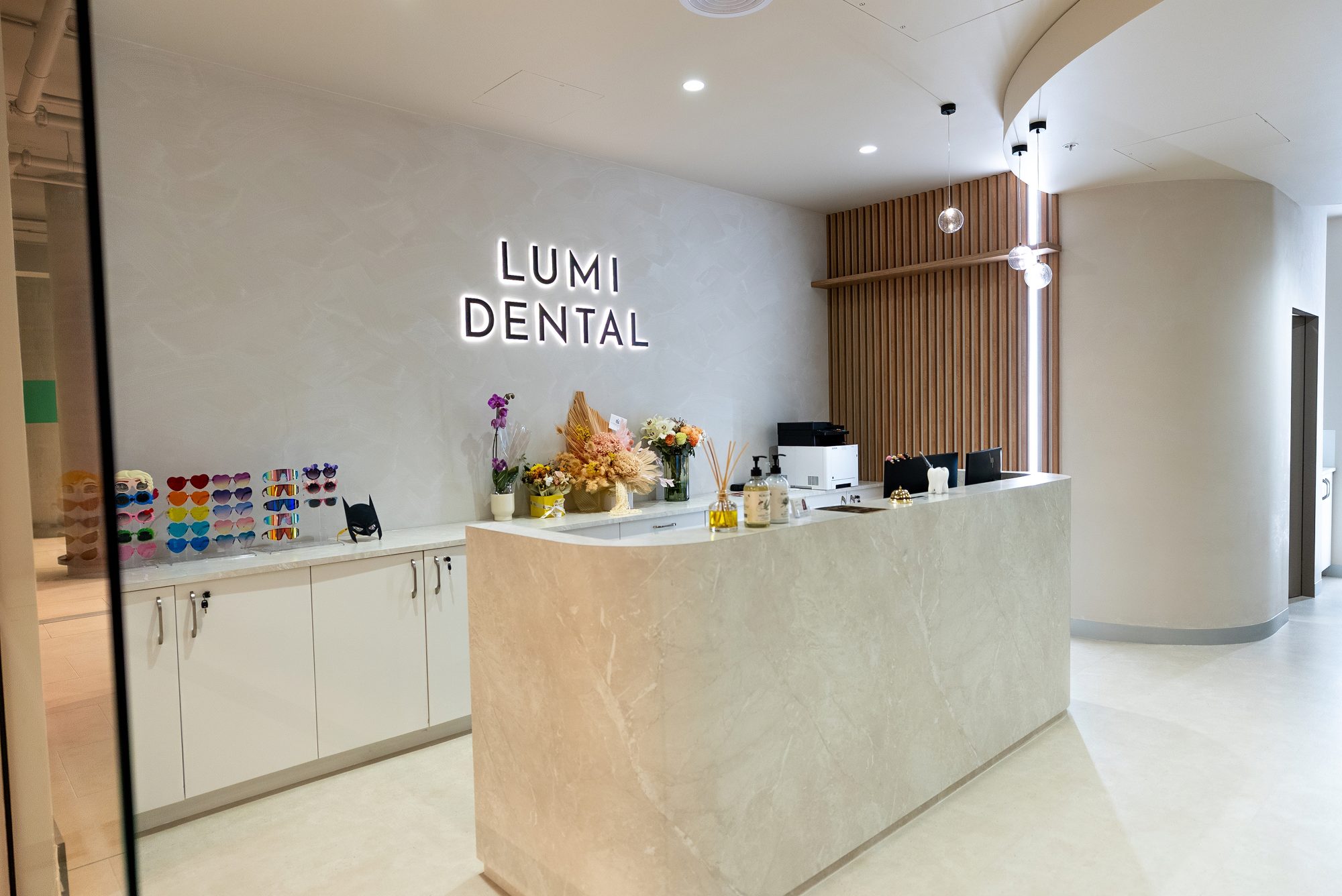
Lumi Dental does not carry out gum grafts; where a graft is needed, the dentist refers you to a registered periodontist. If you want whitening as well, the team at Lumi Dental can whiten before your referral, or wait for the periodontist's clearance and plan around their advice. The dentist examines the gums and graft site, checks any exposed roots for decay and sensitivity, and takes a new in-house 3D intraoral scan for trays once the gum line is stable. The oral health therapists look after cleans and gum health. The whitening options are named Lumi Home, Lumi Refresh and Lumi Radiance; read more about cosmetic dentistry at Lumi Dental.
Questions patients ask
How long after a gum graft can I whiten my teeth?
There is no single number. Research suggests a graft is integrating at around 2 months and keeps settling for months after, so whitening usually waits until the periodontist who did the graft confirms it has healed.
Should I whiten my teeth before or after a gum graft?
Before is often simpler, because the gum is intact and the trays fit the current gum line. Tell the periodontist, and let any sensitivity settle before surgery.
Can whitening gel damage a gum graft?
Strong gel can burn gum tissue, and a new graft is more delicate than healthy gum. That is why gel is kept well away from a graft until it has healed and trays are trimmed short of the margin.
Will my grafted gum match the rest after whitening?
Whitening does not change gum colour, and a free gingival graft can stay a slightly different shade from the neighbouring gum. Our guide to gum graft surgery explains the main graft types.
Do I need new whitening trays after a gum graft?
Usually, yes. Trays made before surgery follow the old gum line, so a new scan after healing gives an edge that stays off the graft. A complimentary cosmetic consult is a good time to check.
Thinking about whitening? Complimentary cosmetic consult in Melrose Park
If you have had a gum graft, or one is planned, the team at Lumi Dental can look at your gums and teeth and suggest an order and timing that protects the graft. Book a complimentary cosmetic consult at Melrose Central in Melrose Park, or read more about teeth whitening at Lumi Dental. Patients visit from Ryde, Parramatta, Ermington and Rydalmere, with on-site parking.
Sources
- Australian Dental Association (teeth.org.au): Teeth whitening
- PubMed: Histological evaluation of healing and revascularization of the subepithelial connective tissue graft
- PubMed: Vascularization and Innervation of Connective Tissue Grafts in the Treatment of Gingival Recessions: A Histologic and Immunohistochemical Study
- PubMed: Dimensional and colorimetric changes of keratinized tissue following free gingival grafts around teeth: a prospective clinical study
About the author

Dr James Tran is a general dentist at Lumi Dental in Melrose Park. He holds a BDent from the University of Sydney and a Graduate Diploma in Oral Implants, and is a Member of the International Congress of Oral Implantologists (MICOI).
This article is general information only and is not a substitute for an examination and individual advice from a registered dental practitioner. Suitability for any treatment varies from person to person.







