
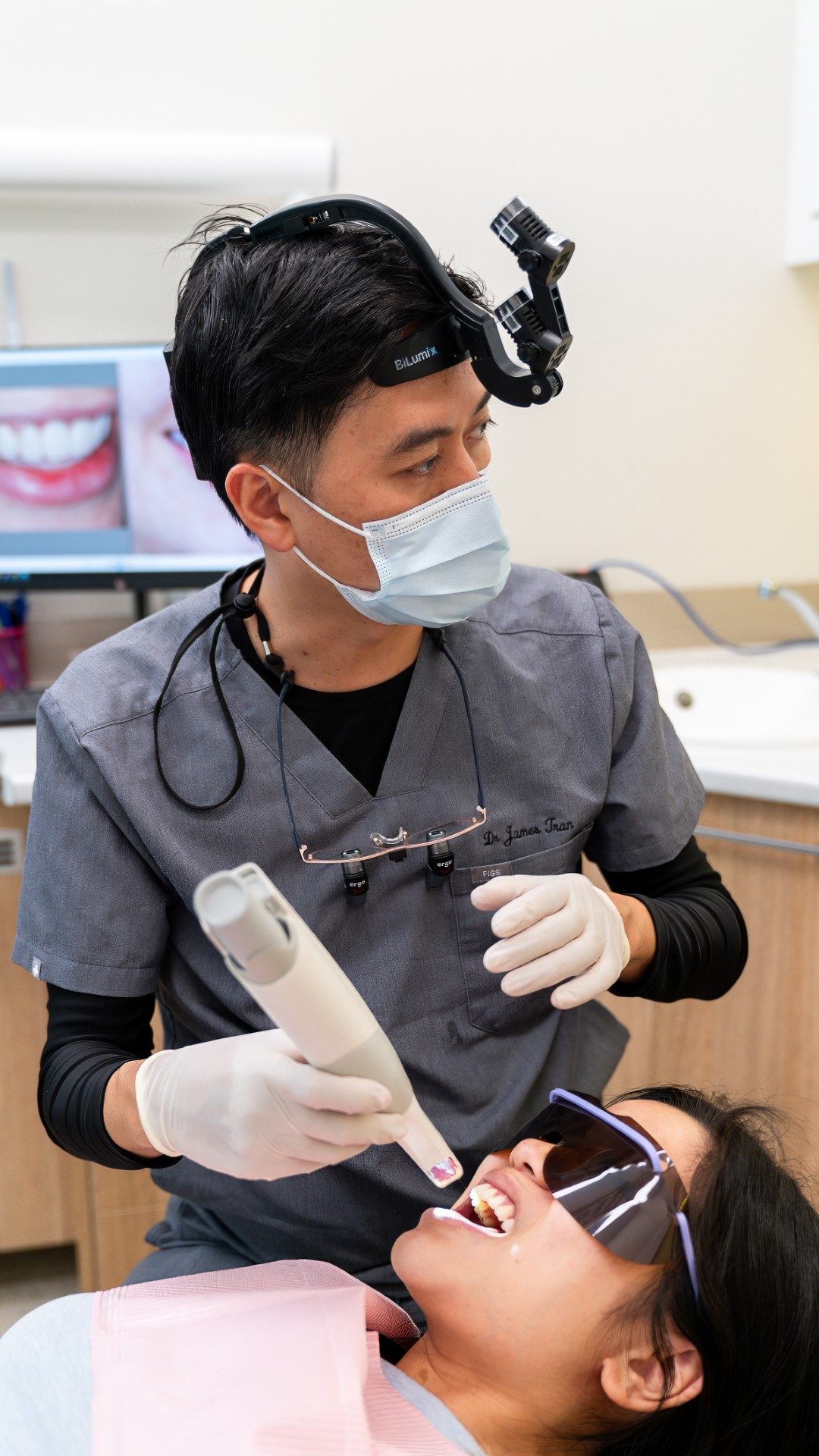

Teeth whitening during acne treatment is often possible, but if you are taking isotretinoin, take-home trays with your lips protected usually suit better than a long in-chair session, and many people choose to wait until the course ends and their lips have recovered. The whitening gel works on the teeth. What isotretinoin changes is the mouth around them: dry, cracked lips, a drier mouth and more fragile skin. In a prospective study of 60 people taking isotretinoin, 75% developed cheilitis (sore, cracked lips) and half reported a dry mouth.
Written by Dr James Tran, BDent (University of Sydney), MICOI, GradDip (Oral Implants), general dentist at Lumi Dental in Melrose Park.
The short version
- Isotretinoin does not react with whitening gel. The issues are dry, cracked lips, a dry mouth and skin that burns more easily.
- A long in-chair session stretches the lips with a retractor, and strong gel stings cracked skin. Take-home trays are usually gentler.
- Many people simply wait until the course has finished and their lips have healed, then whiten.
- Your GP or dermatologist leads your acne treatment. Never stop or change a medicine for the sake of whitening.
- Acne antibiotics matter too: doxycycline can increase sun sensitivity, and minocycline can rarely grey adult teeth. Our article on medicines and teeth whitening covers the wider list.
- Teenagers on isotretinoin are usually better served by waiting.
What isotretinoin does to the lips and mouth
Isotretinoin is a vitamin A derivative taken by mouth for acne. It works by shrinking the oil glands in the skin, and the same drying effect shows up on the lips, inside the nose and in the mouth. DermNet lists dry lips and cheilitis among the most common side effects and notes that side effects are dose dependent, so at higher doses nearly everyone has them. It also lists fragile skin and sunburn on exposure to the sun. Courses often run for several months.
The mouth itself can dry out. In the prospective study of 60 patients, dry mouth affected half, mouth ulcers about one in six and gum changes a little over one in eight, all mild to moderate. A small French study measured saliva flow during treatment and found it fell gradually, then returned to baseline about two months after the course ended. The same study recorded a small rise in decayed, missing and filled teeth in the treated group, which is a reason to keep up check-ups during a course.
Healthdirect's acne treatment page describes oral retinoids as causing severe skin dryness and sensitivity to the sun, and suggests moisturisers, lip balm and sun protection to manage them.
Why a long in-chair session can be hard on dry lips
In-chair whitening holds the lips and cheeks back with a retractor for the length of the appointment, while a strong hydrogen peroxide gel is painted onto the front teeth in rounds. For lips that are already split at the corners, that stretch can reopen cracks. Teeth.org.au, the Australian Dental Association's consumer site, warns that strong gel can cause chemical burns if it touches the lips, gums or tongue, and that these burns often turn into ulcers before they heal. On cracked skin, even a small smear is likely to sting.
In-chair sessions often use a light over the teeth. There is little research on whitening lights and isotretinoin specifically, so the sensible position is caution rather than a rule: if your prescriber has warned you about light or sun sensitivity, say so, and the dentist can suggest trays or a session without a light.
Our article on cracked mouth corners explains why splits at the corners can be slow to heal once they start.
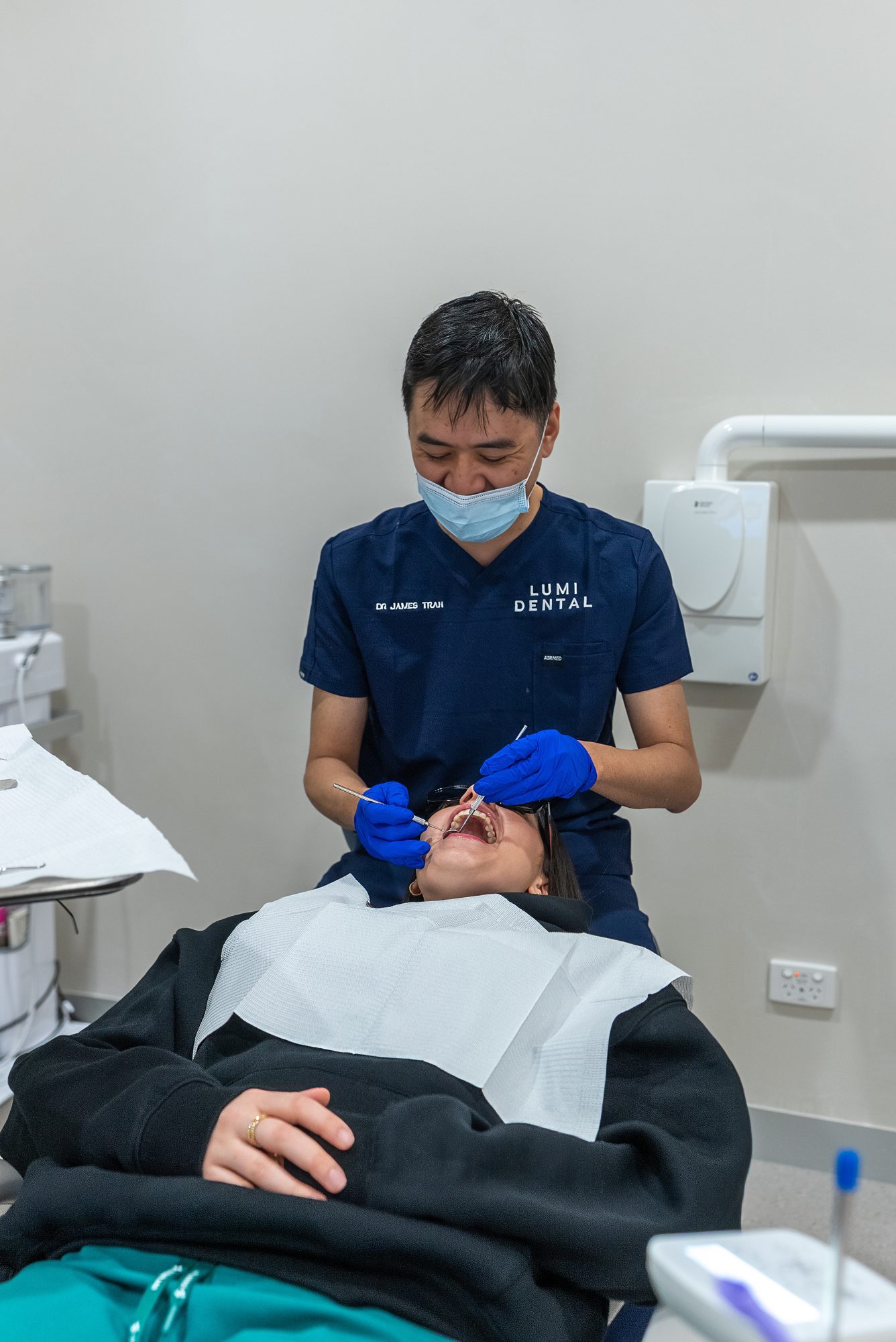
The simple rule: during an isotretinoin course, start with trays or wait
If you are taking isotretinoin and want to whiten now, start with take-home trays, protect your lips, and keep sessions short. If your lips are cracked or bleeding, wait until the course has finished and they have healed.
Take-home whitening uses thin custom trays and a lower-strength gel. Your mouth stays closed, nothing stretches the lips, and you can stop a session at any time. A few habits help:
- Put lip balm on the lips before you seat the tray, keeping it off the teeth so the gel still reaches the enamel.
- Use only a small amount of gel, and wipe away anything that squeezes onto the gums or lips.
- Choose shorter wear times, or whiten every second day, if your mouth feels dry.
- Stop and call the practice if a lip crack becomes painful or a mouth ulcer appears.
In my experience, waiting a couple of months after the course often makes whitening easier: the lips are comfortable, saliva has usually recovered, and sessions go ahead with fewer interruptions.
What your dermatologist's skin advice does and does not cover
People on isotretinoin are often told to avoid some cosmetic procedures. DermNet advises against mechanical dermabrasion and ablative laser treatments during treatment and for six months afterwards, and suggests shaving rather than waxing. The Australasian College of Dermatologists' position statement takes a slightly less strict line on some procedures, while still not recommending dermabrasion or fully ablative laser.
That advice is about skin healing. Whitening is a tooth treatment, and none of these guidelines mention it directly, so there is no published rule to quote. The sensible step is to ask your prescriber whether anything about your course, such as how dry or fragile your skin is, should change your timing. The GP or dermatologist leads the acne treatment; the dental team plans around it.
Dry mouth and sensitivity during a course
Saliva protects teeth between whitening sessions and dilutes any gel that drifts onto the gums. With less of it, teeth can feel cold more sharply and the gums can become tender. Our article on whitening with a dry mouth explains the usual adjustments, such as a lower-strength gel, shorter wear and a sensitivity toothpaste beforehand.
When I see someone partway through a course, I look at the lips and mouth corners before the teeth. Hidden decay also matters more than the gel. Because the French study found a small rise in decay during treatment, the dentist checks for early decay and gum inflammation before trays are made.
Acne antibiotics: doxycycline and minocycline
Antibiotics are another common acne treatment. Healthdirect notes that doxycycline can make the skin more sensitive to sunlight, so if you are taking it, mention it before an in-chair session with a light is booked. Minocycline is the one to know about for tooth colour: a survey of acne patients described it as an uncommon cause of grey staining in adult teeth, and whitening may only partly lighten that colour. Our article on teeth staining from medication explains this, so it is not repeated here.
Teenagers on isotretinoin
Many people prescribed isotretinoin are teenagers. For them, waiting until the course has finished is usually the simplest plan, because dry lips and a drier mouth add to the reasons whitening is often better left until the later teens anyway. Our article on whether whitening is safe for teenagers covers that for parents.
| Acne treatment | What it can do to the mouth or lips | What it changes about whitening |
|---|---|---|
| Oral isotretinoin | Dry, cracked lips; dry mouth; fragile skin that burns easily | Trays with lips protected, short sessions, or wait until the course ends |
| Doxycycline | Skin more sensitive to sunlight | Mention it before an in-chair session with a light |
| Minocycline | Uncommonly, a grey tinge on adult teeth | Whitening may only partly lighten it; set expectations first |
| After an isotretinoin course | Lips heal; saliva usually recovers within a couple of months | Whitening can usually be planned as for anyone else |
How we approach this at Lumi Dental
Whitening at Lumi Dental starts with an examination by the dentist and a medical history that asks about every medicine, including acne tablets and creams. The dentist looks at the lips and mouth corners, checks for dry mouth, early decay and gum inflammation, and records the starting shade with clinical photographs. If you are partway through isotretinoin, the team may suggest trays, a later start, or both. The options are named Lumi Home, Lumi Refresh and Lumi Radiance, and the teeth whitening page explains how the consult works.
Questions patients ask
Can I get my teeth whitened while on Accutane?
Often, yes, with care. Accutane and Roaccutane are brand names for isotretinoin, and the main concern is dry, cracked lips rather than the teeth, so take-home trays with protected lips usually suit better than a long in-chair session.
How long after isotretinoin should I wait to whiten my teeth?
There is no fixed rule for whitening. Many people wait until their lips have healed, and one small study found saliva flow returned to normal about two months after the course ended. Ask your prescriber if your skin was very fragile.
Should I stop isotretinoin to whiten my teeth?
No. Never stop or change a medicine for a cosmetic treatment. The whitening plan is adjusted around the medicine, and your GP or dermatologist makes any decisions about the course.
Why do my teeth feel more sensitive on isotretinoin?
A drier mouth means less saliva to protect the teeth, so whitening sensitivity can feel sharper. Our guide to how long whitening sensitivity lasts covers the usual pattern.
Can doxycycline stain my teeth?
In adults, staining from doxycycline is not the usual concern. Healthdirect notes it can affect tooth enamel while teeth are developing, which is why it is not taken by young children or after 16 weeks of pregnancy; for adult whitening, its main relevance is sun sensitivity. A complimentary cosmetic consult is a good time to go through your medicines.
Thinking about whitening? Complimentary cosmetic consult in Melrose Park
If acne treatment has you unsure about timing, the team at Lumi Dental can check your lips, mouth and teeth and suggest when and how to whiten. Book a complimentary cosmetic consult at Melrose Central in Melrose Park, or read more about teeth whitening at Lumi Dental. Patients visit from Ryde, Parramatta, Ermington and Rydalmere, with on-site parking.
Sources
- Healthdirect: Acne treatments
- DermNet: Isotretinoin
- PMC: Oral side effects of isotretinoin therapy in acne patients, a prospective study
- PubMed: Reduced salivary flow induced by systemic isotretinoin may lead to dental decay, a prospective clinical study
About the author

Dr James Tran is a general dentist at Lumi Dental in Melrose Park. He holds a BDent from the University of Sydney and a Graduate Diploma in Oral Implants, and is a Member of the International Congress of Oral Implantologists (MICOI).
This article is general information only and is not a substitute for an examination and individual advice from a registered dental practitioner. Suitability for any treatment varies from person to person.








