

The test most people find easiest to remember is the fork test. If you can cut a food with the side of a fork, it is usually fine on a provisional full-arch bridge. If you would need your front teeth to tear it or your back teeth to crack it, it waits until the final bridge is in. The temporary teeth look finished, but the implants under them are still healing.
Written by Dr James Tran, BDent (University of Sydney), MICOI, GradDip (Oral Implants), general dentist at Lumi Dental in Melrose Park.
The implants are held by grip, not yet by bone
A bridge fitted on the day of surgery is screwed to implants that have not yet fused with the bone. For now they are held by how tightly they were seated. Bone grows onto the implant surfaces over the following months, and repeated movement under heavy load during that time can get in the way. Our guide to immediate-load implants explains why early stability matters so much.
The provisional bridge is also built for the healing phase rather than for the long term. It is usually acrylic, lighter than the final bridge and often a little shorter at the back, because teeth that extend past the last implant act as a lever on it. The bite is adjusted so chewing forces spread evenly across all the implants.
Soft diets during this stage are standard practice in published full-arch studies. In a study that followed full-arch bridges on four or six implants for up to ten years (La Monaca and colleagues, Clinical Implant Dentistry and Related Research, 2022), patients were asked to keep to a soft diet for two months after surgery.
Why tearing and cracking are the problem
Biting into food with the front teeth and pulling puts leverage on the front implants and on the thin acrylic over them. Cracking something hard between the back teeth loads the part of the bridge that is shortest and least supported. A sandwich on soft bread is fine; a crusty roll is not. Poached fish is fine; a steak you have to saw and tear is not.
Chew on both sides at the same time where you can. The bridge is one rigid piece, so chewing only on the left tips it and loads the implants on the right.
A week by week guide
This is a general schedule, not a prescription. Your dentist's written instructions come first, and each stage may run longer if healing is slow, grafting was done, or you grind.
| When | Usually fine | Leave for now | Why |
|---|---|---|---|
| First three days | Cool or lukewarm smooth food: yoghurt, custard, blended soup, mashed potato, smoothies, protein shakes | Anything hot or chewed, straws, alcohol | Fresh sockets and stitches; take pain relief as advised |
| Rest of week one | Soft scrambled eggs, porridge, soft fish, well-cooked pasta, avocado, ripe banana, silken tofu | Bread crusts, meat, raw salad, crisps | Swelling settling; gum under the bridge is tender |
| Week two | As above, plus mince, slow-cooked meat, lentils, soft rice dishes | Anything you need to tear or crunch | Stitches often come out; bite checked |
| Weeks three and four | Fork-tender food: flaky fish, shredded chicken, soft crustless bread, cooked vegetables, soft fruit | Steak, crusty bread, nuts, raw carrot, popcorn, toffee | Implants mid-healing; acrylic chips easily |
| Weeks five to eight | Most cooked meals, cut small and chewed on both sides | Hard, crunchy and sticky food, ice, bones | End of a typical two-month soft diet |
| From then until the final bridge | A gradually wider diet, still cut small | The same hard and sticky list | Confidence grows and acrylic wears, which is when chips tend to happen |
| Final bridge fitted | Most foods | Ice, bones, very hard crusts, opening packets with your teeth | The final bridge handles normal chewing |
Guy's and St Thomas' NHS Foundation Trust advises taking painkillers before the anaesthetic wears off and for the first 48 hours after implant treatment, and notes that discomfort should last no more than about a week. If pain is getting worse instead of easing, call us.
Two months is long enough to lose weight
Healing gum and bone need protein, and a soft diet can drift towards custard and ice cream. Build each day around soft protein: eggs, Greek yoghurt, cottage cheese, flaked fish, slow-cooked or minced meat, lentils and tofu, with a shake on days when your appetite is low. Drink water through the day, keep tea and coffee warm rather than hot in the first week, and avoid alcohol while you are taking strong pain relief. The soft phase after a full arch lasts weeks, not days, so it is worth planning the shopping before surgery.

Chips usually come from grinding and harder food
A chipped provisional is the most common mechanical setback, and it is rarely serious. In a case series of eight patients who had upper and lower provisional bridges fitted on the same day (Cercadillo-Ibarguren and colleagues, Journal of Clinical and Experimental Dentistry, 2017), three had a fracture of the provisional, all at around three months, and all three ground their teeth even though they wore a splint. The authors pointed to grinding, a gradual move back to a normal diet, and wear of the acrylic as risk factors, and the fractures did not affect whether the implants integrated.
If a piece chips off, keep it, call us and avoid chewing on that side. Do not glue it; household glues are not safe in the mouth. Most chips are smoothed or rebuilt in the chair, and a cracked bridge can be removed, repaired and refitted. Our article on a chipped or broken full-arch bridge explains what happens next. If you grind or clench, wear the night guard if one is made for you; our article on implants and grinding explains why.
Cleaning after meals
Soft food packs under a bridge, and the gap under a provisional is larger than it will be under the final bridge because the gum is still shrinking. Guy's and St Thomas' advises not brushing the implant area for the first week and using a chlorhexidine mouthwash twice a day; your dentist will tell you exactly what to use. After that, use a soft brush along the gum line, a water flosser on low pressure aimed under the bridge after meals, and a thick floss threaded under the bridge once a day. Our guide to cleaning a full-arch implant bridge at home covers the full routine.
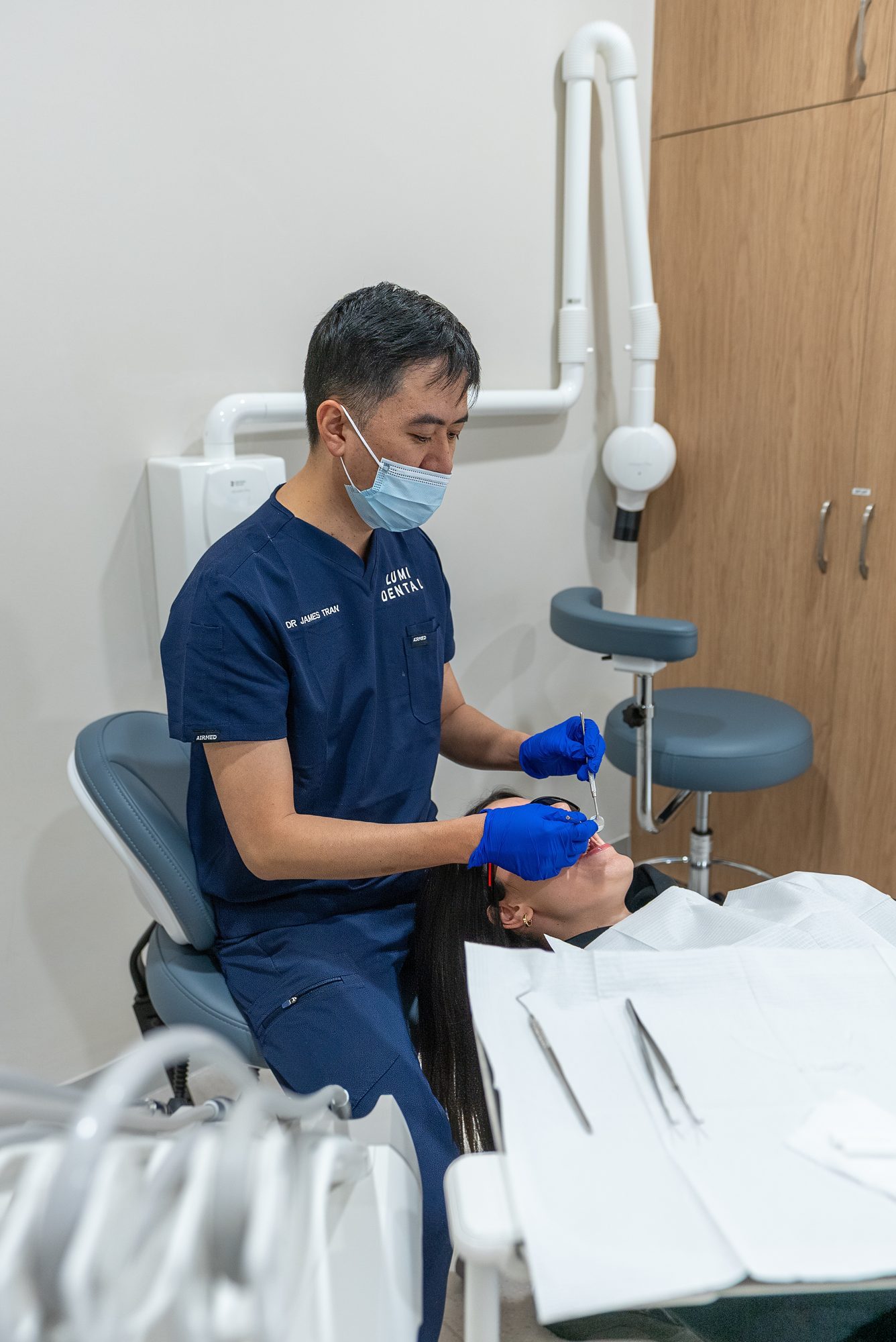
At Lumi, full-arch cases are planned on our 3D X-ray and intraoral scan, and the provisional is designed before surgery so the bite can be adjusted on the day. You are given food and cleaning instructions for each stage, and early reviews check the bite and the screws. You can read more about full-arch implants at Lumi, or see our full-arch treatment timeline for how the provisional stage fits into the whole plan.
Questions we are often asked
When can I eat normally again?
Most people return to a broad diet once the final bridge is fitted, several months after surgery. Until then the diet widens in steps, with hard, crunchy and sticky food left out.
Can I eat a sandwich?
Usually from about the third week, if the bread is soft and the filling does not need tearing. Crusty rolls and toasted sandwiches wait for the final bridge.
Why does my temporary bridge have fewer back teeth?
It is often shortened on purpose. Teeth that extend beyond the last implant act like a lever on it while it heals. The final bridge is often longer; our comparison of zirconia and acrylic full-arch bridges explains the materials.
What if I bite on something hard by accident?
Usually nothing happens, though sometimes a chip. Check the bridge in a mirror, and call us if anything feels loose or your bite feels different. A bridge that feels loose on the implants needs to be seen promptly.
If you are considering a full-arch bridge, book a free implant consult at our Melrose Park practice and we will take a 3D X-ray and talk you through the provisional stage before anything is booked. Contact us, or read about dental implants at Lumi.
Sources
- La Monaca G and colleagues. Immediate flapless full-arch rehabilitation of edentulous jaws on 4 or 6 implants: outcomes up to 10 years. Clinical Implant Dentistry and Related Research, 2022
- Cercadillo-Ibarguren I and colleagues. Bimaxillary simultaneous immediate loading of full-arch restorations: a case series. Journal of Clinical and Experimental Dentistry, 2017
- Peñarrocha-Oltra D and colleagues. Immediate loading with fixed full-arch prostheses in the maxilla: review of the literature. Medicina Oral, Patologia Oral y Cirugia Bucal, 2014
- Guy's and St Thomas' NHS Foundation Trust: After having a dental implant
About the author

Dr James Tran is a general dentist at Lumi Dental in Melrose Park. He holds a BDent from the University of Sydney and a Graduate Diploma in Oral Implants, and is a Master of the International Congress of Oral Implantologists (MICOI).
This article is general information only and is not a substitute for an examination and individual advice from a registered dental practitioner. Suitability for any treatment varies from person to person.








